Contents
- Key takeaways
- What is a pay monthly website package?
- How much do pay monthly websites cost in the UK?
- The real cost of pay monthly website packages over 1, 2 and 3 years
- Who owns a pay monthly website?
- What happens if you stop paying?
- Minimum terms, notice and exit fees: what to ask
- Do you have to pay monthly for a website?
- When pay monthly is the right choice
- The alternative: a one-off build with an optional monthly plan
- A checklist to take before you sign
- Frequently asked questions
Pay monthly website packages spread the cost of a website into a monthly fee, usually with hosting and support included. Typical UK plans run from about £19 to £95 a month (checked October 2026), and the real question is what you have paid, and what you own, after two or three years.
We should say up front that we have a side in this. We build websites for a one-off fee, and our published prices are on the site. So we have tried to show the sums fairly, including the cases where paying monthly comes out cheaper.
Key takeaways
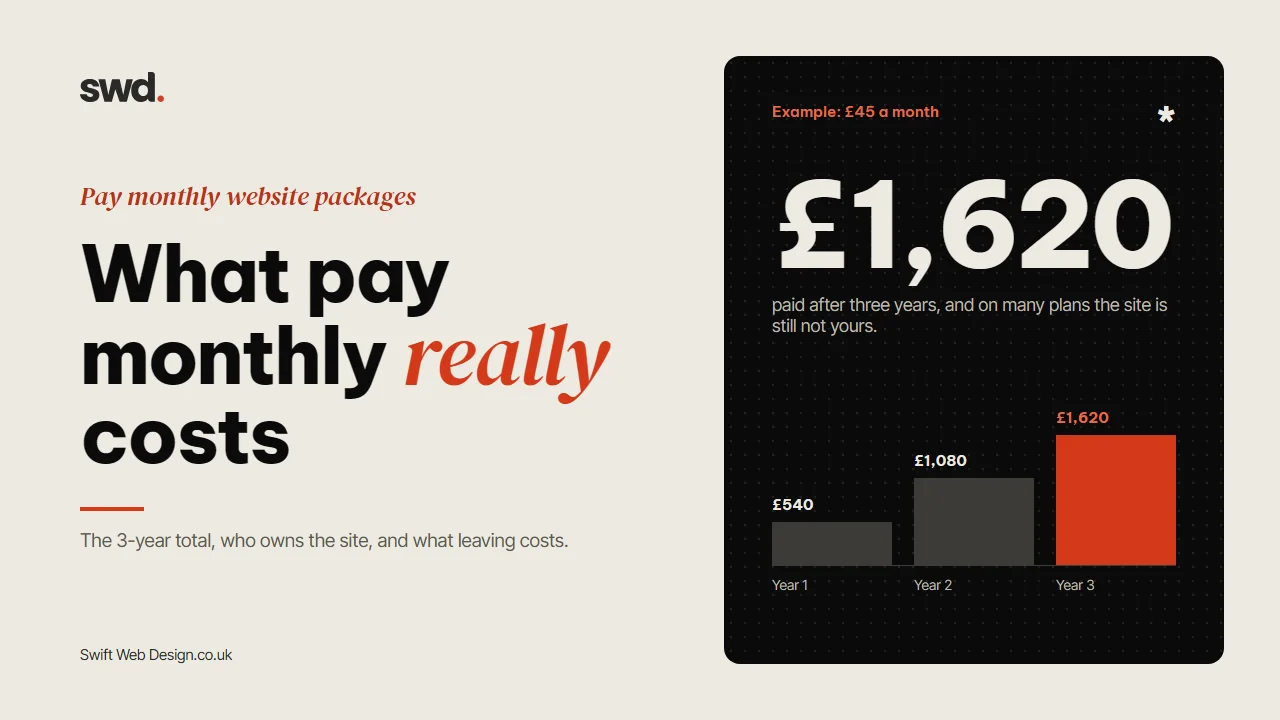
- An example £45 a month plan costs £1,620 over three years, and on many managed plans you do not own the site at the end.
- Ownership is the question many sales pages leave unclear. The domain, the design, the files and the licences can each belong to someone different.
- Before you sign, get three things in writing: whose name the domain is registered in, whether you get a full copy of the site, and what leaving costs.
- Paying monthly can be the right call when cash flow matters more than the three-year total, or when nobody in the business wants to look after a website.
What is a pay monthly website package?
A pay monthly website package is a website you pay for in monthly instalments instead of one upfront bill. The monthly fee usually covers the design, hosting, a security certificate and some small edits. Some plans hand the site over at the end of a fixed term. Others never do, and you rent the site for as long as you keep paying.
Three different arrangements are sold under the same name, and they behave very differently when you leave:
- A managed rental. You pay a monthly fee for as long as you want the site online. You never own it, and it stops when the payments stop.
- A build spread over a fixed term. You pay off the cost of the build over 12 to 36 months, often with a care plan on top. The site becomes yours once the term is paid.
- A one-off build with an optional monthly plan. You pay for the build once, own it, and choose whether to pay anyone monthly for hosting or upkeep afterwards.
The first two are what most people mean by pay monthly website packages. The third is how we work, and it is the comparison point for the costs below.
How much do pay monthly websites cost in the UK?
These are the typical ranges from the UK plans we checked in October 2026:
- Entry-level managed plans: £19 to £49 a month, usually for up to five pages.
- Larger managed plans, for roughly 4 to 15 pages: £45 to £95 a month.
- Bespoke builds spread over a term: £144 to £274 a month, over 12 to 36 months.
Setup fees on pay monthly website packages are usually £0, which is a large part of the appeal. Terms range from rolling monthly with no contract to fixed periods of 12, 24 or 36 months.
Most plans include hosting, an SSL certificate, a domain name and email. Small content changes are usually included too, but check what counts as an edit and whether "unlimited" has a monthly time limit in the small print. Extra pages, online shops and anything beyond small edits usually cost more. For a fuller picture of what ongoing care should include, see what website maintenance costs in the UK.
The real cost of pay monthly website packages over 1, 2 and 3 years
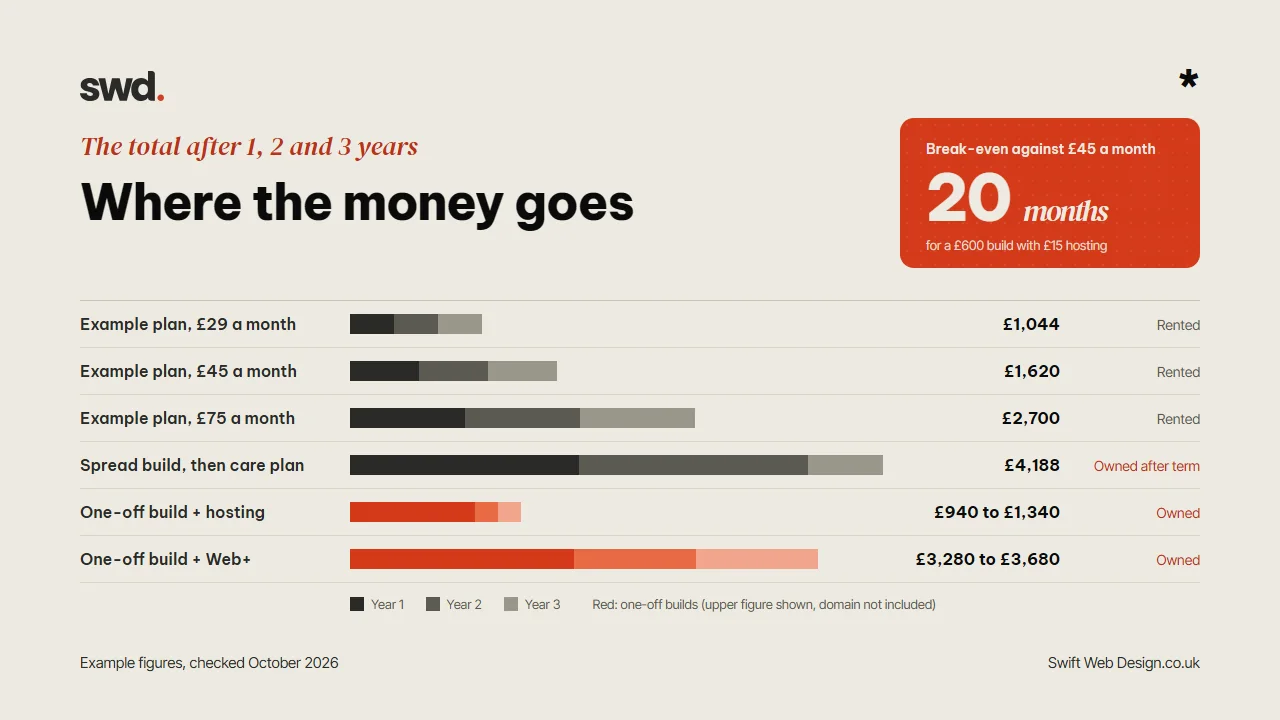
A low monthly figure is easy to say yes to, but the total is what you pay. The pay monthly rows are example prices within the typical ranges above, not any one provider's prices. The one-off rows use our own published prices.
| Arrangement | After 1 year | After 2 years | After 3 years | Yours at the end? |
|---|---|---|---|---|
| Example entry plan at £29 a month | £348 | £696 | £1,044 | Usually not |
| Example managed plan at £45 a month | £540 | £1,080 | £1,620 | Usually not |
| Example managed plan at £75 a month | £900 | £1,800 | £2,700 | Usually not |
| Example build spread at £150 a month over 24 months, then a £49 a month care plan | £1,800 | £3,600 | £4,188 | Yes, once the term is paid |
| One-off Standard build (£400 to £800) plus optional hosting at £15 a month | £580 to £980 | £760 to £1,160 | £940 to £1,340 | Yes, once paid in full and live |
| One-off Standard build plus our Web+ plan at £80 a month (hosting included) | £1,360 to £1,760 | £2,320 to £2,720 | £3,280 to £3,680 | Yes, once paid in full and live |
Figures checked October 2026. Each total is the upfront cost plus the monthly fee multiplied by the number of months. The one-off rows do not include a domain name, which costs around £10 to £20 a year. Most monthly plans include one, so add that if you are comparing like for like. The hosting-only row also does not include edits or support, which most monthly plans do; the Web+ row does.
When does a one-off build work out cheaper?
Take a £600 build with £15 a month hosting. Against a £45 a month plan you save £30 a month, so the build has paid for itself after 20 months (£600 ÷ £30). Against a £75 a month plan it takes 10 months. Against a £29 a month plan it takes about 43 months, so the cheapest plans do stay cheaper for more than three years.
The Web+ row is there on purpose. A one-off site with monthly care costs about the same as a mid-range pay monthly plan. The difference is that you own the site, and you can stop paying for the care without losing it.
Who owns a pay monthly website?
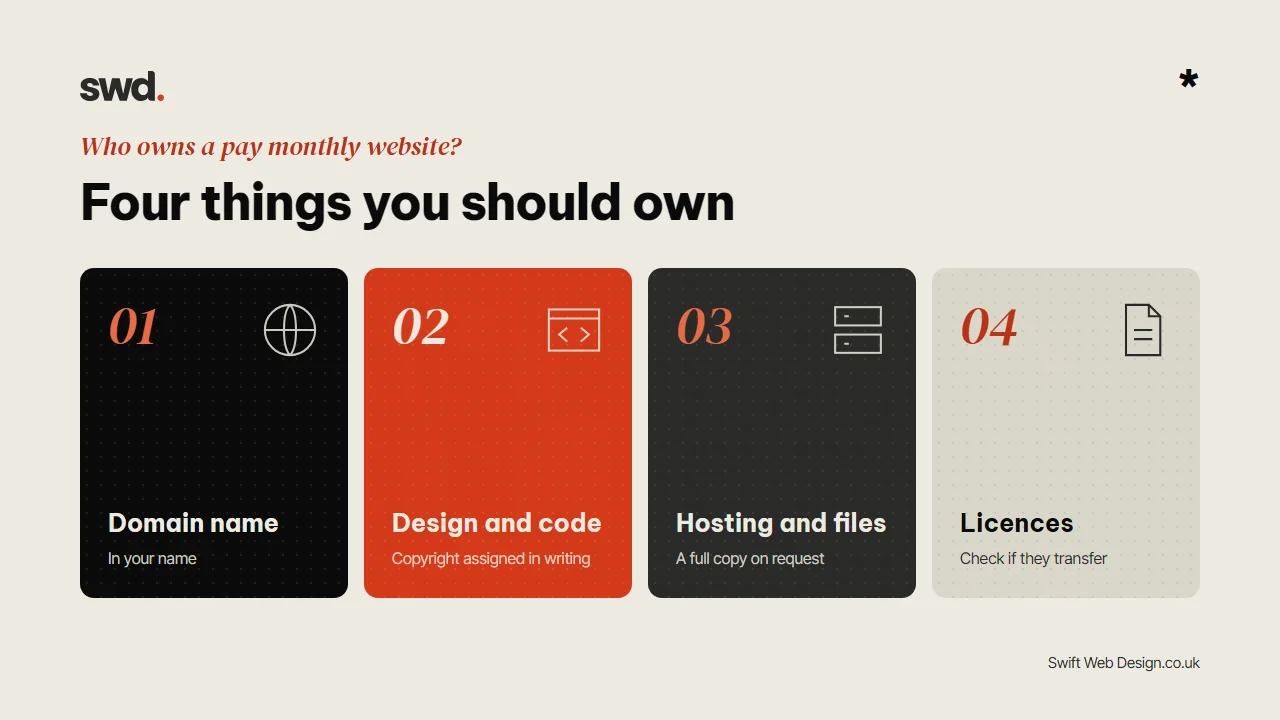
This is the part many pages selling pay monthly website packages leave vague. "Your website" can mean four separate things, and each one can belong to a different person.
The domain name
Your email and every link to your business depend on the domain, so the first thing to check is whose name it is registered in. If a provider registers it in their own name, they control it, even if you have paid for it every year. For a .uk domain you can check the registrant with Nominet's lookup service, although the registrant's details may be hidden for privacy. Moving a .uk domain into your own name is a registrant transfer, which costs £10 plus VAT at Nominet, plus any fee your provider adds. It is much easier to ask for the domain in your name before you sign.
The design, code and content
Under UK law, the person who creates a piece of work generally owns the copyright in it to begin with, or their employer if they made it as part of their job (section 11 of the Copyright, Designs and Patents Act 1988). That ownership only passes to someone else through a written assignment signed by the owner (section 90(3)). Paying for a website does not automatically transfer the copyright to you.
So when a plan says the site is "yours after 12 months", check that the contract says the copyright is assigned to you in writing at that point. This is general information, not legal advice. If a lot of money is involved, ask a solicitor to read the contract.
For comparison, our own terms say that once a site is paid in full and live, we assign the copyright in the design, content and code we made for it, and send a short signed confirmation. We keep our own tools and templates, but you get a permanent free licence to use them as part of the site.
The hosting account and logins
Find out who holds the hosting account and the admin logins, and whether you can have a full copy of the site's files and database whenever you ask.
Theme and plugin licences
Many sites run on paid themes and plugins licensed to the person who built them. Some of those licences cannot be transferred, so ask what happens to them if you move the site elsewhere.
Put together, "yours after 12 months" should mean, in writing: the domain is in your name, the copyright is assigned to you, you get a full copy of the files, and you can move the site to any host without a fee.
What happens if you stop paying?
Every provider is different. These are things we saw in contracts while researching this guide, so check how yours handles each one:
- On a rental plan, the site goes offline when the payments stop. There is nothing to take with you because it was never yours.
- After a missed payment, the account may be suspended soon afterwards, and the files deleted after a set period.
- Some terms let the provider keep the domain if you leave within the first year, unless you pay a release fee.
- Some buy-outs are priced at what the site is worth at the time, not at what you have already paid.
- If your email runs through the provider's hosting, it can stop working the day the site does.
If you do decide to leave, do it in this order. Get the domain into your name first. Then download a full copy of the site and your email. Then set up the new hosting, and only then give notice. Before you go, it is worth running a free website audit so you know what you are moving and what needs fixing.
Minimum terms, notice and exit fees: what to ask
The terms decide what a plan costs you. Ask about these before you sign:
- The minimum term, and whether the plan renews automatically at the end of it.
- The notice period, and how notice has to be given.
- Whether the price can rise after an introductory period, and how much warning you get.
- What you owe if you leave early, as a worked figure for month 6 and month 18.
- How any buy-out price is calculated.
One point catches a lot of people out. A business buying a website for business use generally does not get the 14-day cooling-off period that consumers get, because the Consumer Contracts Regulations 2013 protect individuals buying wholly or mainly outside their trade. That usually includes sole traders buying for the business. New subscription rules are planned for consumer contracts made from 1 January 2027, if Parliament approves them, but the government's draft guidance, published in October 2026, says they do not apply between businesses. For a business, the contract you sign is the protection you have.
Do you have to pay monthly for a website?
No. The only costs you cannot avoid are a domain name, at around £10 to £20 a year, and somewhere to host the site, which you can buy yourself. Everything else is a choice. You can pay for a build once and host it anywhere, use a DIY builder for £10 to £30 a month and do the work yourself, or pay a provider monthly to handle all of it. Our guide to how much a website costs in the UK compares those routes in more detail.
When pay monthly is the right choice
Pay monthly website packages suit some small businesses well. Paying monthly makes sense if:
- cash flow matters more right now than the three-year total;
- nobody in the business wants to deal with hosting and updates;
- you need a site for a short time, such as a trial business or a seasonal project;
- you are comparing against the cheapest plans, which can stay cheaper than a one-off build for three or four years.
It is usually the wrong choice if you expect to keep the site for years or want to be free to change provider. And if a plan will not put the domain in your name, walk away.
The alternative: a one-off build with an optional monthly plan
This is how we work, as of October 2026. You get a fixed quote for an agreed scope before any work starts, and the price does not move once you say yes. Anything extra you ask for later is quoted in writing before we do it. A simple site of one to three pages is around £400, a Standard site of three to eight pages is £400 to £800, larger sites start at £1,000, and fully bespoke builds start at £1,250. There is no VAT to add, because we are not VAT registered.
Once the site is paid in full and live, it is yours. We assign the copyright in writing, and domains we register for clients go in the client's name.
Hosting is optional at £15 a month, or you can host the site anywhere you like. If you want someone to look after it, our Web+ plan is £80 a month with hosting included. Our monthly plans have a two-month minimum term, then run month to month, and you can cancel by emailing us at least a week before the next billing date. The only thing that stays is a small "Website by Swift Web Design" credit in the footer, which costs £10 to remove. Our website building page shows how a build runs.
A checklist to take before you sign
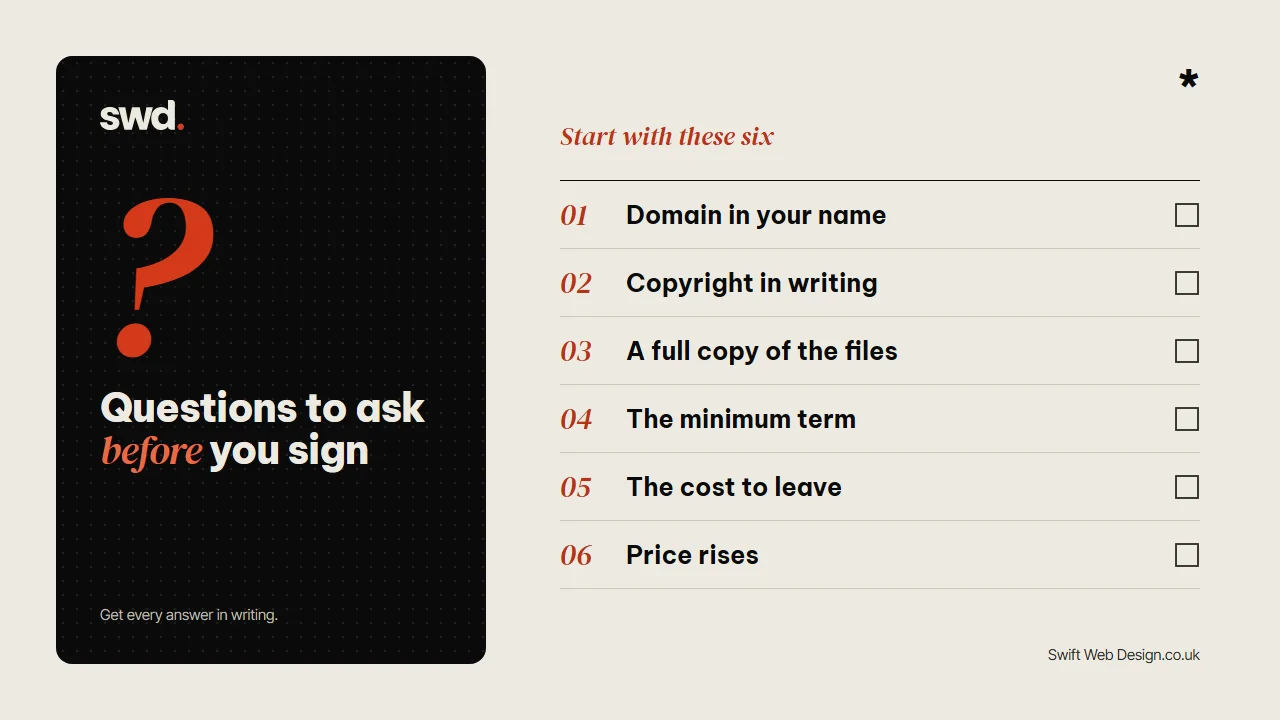
Before you sign up to any pay monthly website package, ask these questions and get the answers in writing:
- Whose name will the domain be registered in? A good answer is yours, from day one.
- Will you assign the copyright in the design and content to me in writing? A good answer is yes, with the point it happens.
- Can I have a full copy of the files and database at any time? A good answer is yes, without a fee.
- What is the minimum term, and does it renew automatically?
- How much notice do I need to give, and how?
- What would it cost to leave in month 6, and in month 18? A good answer is a figure.
- Can the monthly price go up, and with how much warning?
- What happens to the site and my email if a payment fails?
- How many edits a month are included, and what counts as an edit?
- Who holds the hosting account and the admin logins?
This guide is general information, not legal or financial advice. Prices and terms change, so check the current contract of any provider, including us, before you sign.
Frequently asked questions
What is a pay monthly website?
A pay monthly website is a website you pay for in monthly instalments, usually with hosting and small edits included. Some plans hand the site over after a fixed term of 12 to 36 months. Many are rentals, so the site stays with the provider and goes offline when you stop paying.
Is it normal to pay monthly for a website?
Yes, it is common, and typical UK plans run from about £19 to £95 a month. It is not the only way. You can pay for a website once and only pay monthly for hosting, which is often £15 a month or less. Compare the total over the years you expect to keep the site, and who owns it.
Do I own a pay monthly website?
It depends entirely on the contract. On a managed rental you never own the site. On a spread-cost plan it usually becomes yours once the term is paid. Under UK law, copyright generally only passes with a written, signed assignment, so check the contract says that, and that the domain is registered in your name.
What happens if I cancel a pay monthly website?
On a rental plan the site normally goes offline, and the files may be deleted after a set period. On a fixed-term plan you may owe the rest of the term or a buy-out fee to keep the site. Check the notice period, the exit cost at different months, and whether the provider holds your domain.
Is there a setup fee for pay monthly websites?
Usually not. Most UK pay monthly plans we checked in October 2026 had no setup fee. The cost is spread into the monthly fee instead, so compare the total over two or three years and the minimum term.
Can I move my pay monthly website to another company?
Only if the contract allows it. On a rental plan there is often nothing to move, because the provider owns the design and files. On other plans you can move once the term is paid. Ask for a full copy of the files and database, the domain in your name, and the copyright assigned to you in writing.
Who owns the domain name on a pay monthly plan?
Whoever it is registered to, which is not always the person paying for it. Some providers can register domains in their own name. For a .uk domain you can check with Nominet's lookup, and a registrant transfer costs £10 plus VAT at Nominet. The simplest fix is to ask for the domain in your name before you sign.
Are pay monthly websites worth it?
They can be, if cash flow matters more than the long-term total or nobody wants to manage the site. Over three years, an example £45 a month plan costs £1,620, against £940 to £1,340 for a one-off Standard build with hosting. The cheapest plans can stay cheaper for longer, so work out the total for your situation.
Need a website that works this hard?
We design fast, findable websites for UK small businesses. Clear pricing, no jargon.