Contents
- Key takeaways
- What must a UK business website show, by business type?
- Which law applies to sole traders and partnerships?
- Do I need my company number on my website?
- Do I have to put my address on my website, and can it be my home address?
- Do I need a phone number on my website?
- Does my VAT number have to be on my website?
- What extra information does a regulated business need to show?
- Legal requirement or good practice?
- Does my website need a privacy policy and a cookie banner in 2026?
- What extra rules apply if I sell online?
- What should my website footer say?
- Frequently asked questions
- Sources
A UK business website must show who runs it and how to contact them: the name of the person or company running the business, a geographic address and an email address, plus a VAT number if the business is VAT registered. A limited company must also show its registered name, company number, registered office and the part of the UK it is registered in. Sole traders and partnerships have to follow most of these rules too.
We checked the rules in this guide against the legislation on legislation.gov.uk and the ICO's guidance in October 2026. We are web designers, not solicitors, so this is general information, not legal advice, and the law can change after that date. If your business is regulated or your situation is unusual, check with a solicitor or your trade body. For the wider basics of running a small business site, see our guide to small business website help in the UK.
Key takeaways
- Every business website, whatever the business structure, should show the name of the person or company running the business, a geographic address and an email address, because regulation 6 of the Electronic Commerce Regulations 2002 requires them.
- A limited company website must also show the registered name, company number, registered office address and where the company is registered, under regulation 25 of the Trading Disclosures Regulations 2015.
- A VAT number must be shown if the business is VAT registered, and a regulated business must name its regulator or register, under the same regulation 6.
- Terms of use and disclaimers are good practice. No general law requires them. Privacy information and cookie consent depend on what the site does with data.
What must a UK business website show, by business type?
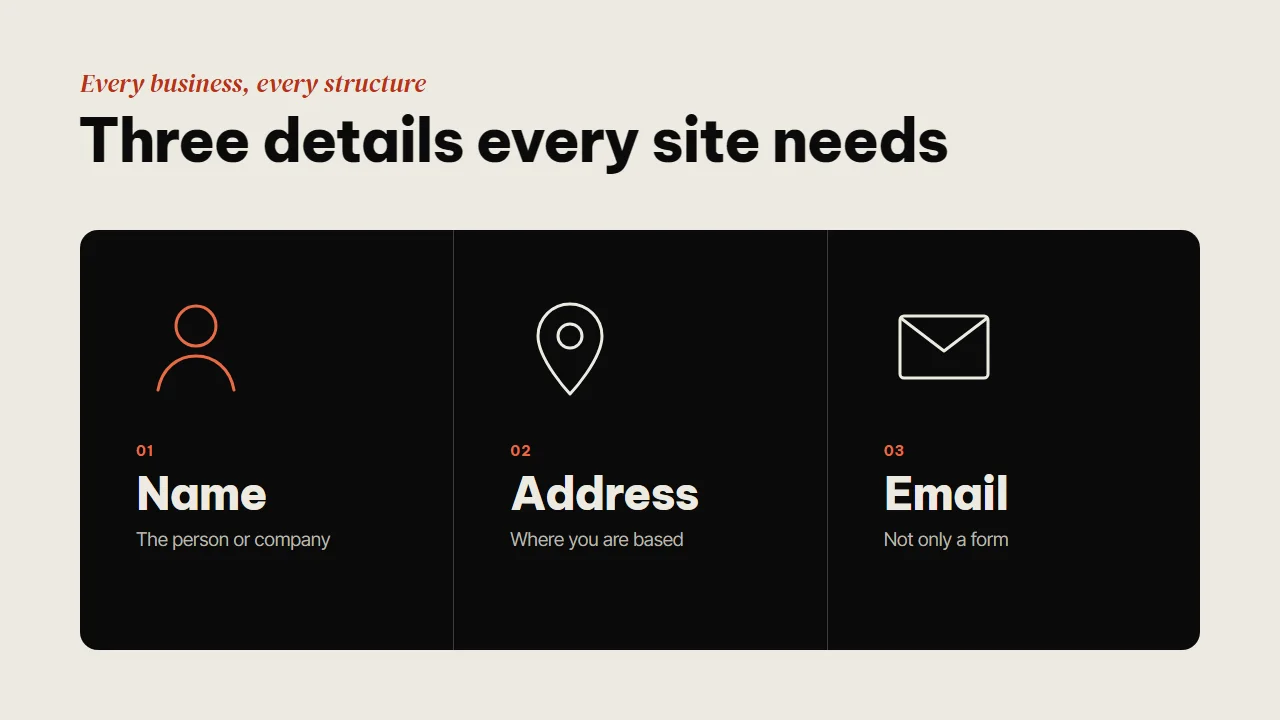
Every business type needs a name, an address and an email address on its website. Companies and LLPs add their registered details. The table shows what each type should show and which law requires it.
| What to show | Limited company or LLP | Sole trader | Partnership | Where the rule comes from |
|---|---|---|---|---|
| Name of the person or company running the business | Yes, the full registered name | Yes, the sole trader's own name | Yes, the partnership's name | Electronic Commerce Regulations 2002, reg 6; Trading Disclosures Regulations 2015, reg 24 for companies |
| Geographic address where the business is established | Yes | Yes | Yes | Electronic Commerce Regulations 2002, reg 6 |
| Email address | Yes | Yes | Yes | Electronic Commerce Regulations 2002, reg 6 |
| Company number | Yes | No | No | Trading Disclosures Regulations 2015, reg 25 |
| Registered office address | Yes | No | No | Trading Disclosures Regulations 2015, reg 25 |
| Part of the UK where registered (for example England and Wales) | Yes | No | No | Trading Disclosures Regulations 2015, reg 25 |
| VAT number | If VAT registered | If VAT registered | If VAT registered | Electronic Commerce Regulations 2002, reg 6 |
| Regulator or public register details | If regulated or registered | If regulated or registered | If regulated or registered | Electronic Commerce Regulations 2002, reg 6 |
Most businesses put these details in the website footer, so they appear on every page. The E-Commerce Regulations ask for the information to be "easily, directly and permanently accessible", and a footer or a clearly linked contact page is the usual way to do that.
Which law applies to sole traders and partnerships?
Sole traders and partnerships are covered by regulation 6 of the Electronic Commerce (EC Directive) Regulations 2002, not by the company disclosure rules. That regulation applies to anyone providing an "information society service", which is any service normally provided for payment, at a distance, by electronic means and at the individual request of the person receiving it.
The Companies Act 2006 does set disclosure rules for sole traders and partnerships trading under a business name, but section 1202 lists business letters, orders, invoices, receipts and payment demands. It does not mention websites. Several guides blur these two sets of rules together, which can leave sole traders with conflicting answers.
Whether a simple brochure site counts is not spelled out in the regulations. The EU directive they implement says in recital 18 that the term also covers services that are not paid for by the people using them, such as online information and advertising, so most business websites are treated as covered. The details cost nothing to show, so the safe course is to show them whatever your business structure.
Do I need my company number on my website?
Yes, if you are a limited company. Regulation 25 of the Company, Limited Liability Partnership and Business (Names and Trading Disclosures) Regulations 2015 (the Trading Disclosures Regulations) says every company must show its registered number, its registered office address and the part of the UK where it is registered on its websites.
Regulation 24 of the same regulations adds that a company must show its registered name on its websites. That means the full name on the Companies House register, including "Limited" or "Ltd", not only a trading name or logo. The same rules apply to LLPs, under regulation 14 of the LLP Regulations 2009. Failing to comply without a reasonable excuse is an offence for the company and every officer in default, under regulation 28. Some guides still cite the Companies (Trading Disclosures) Regulations 2008. Those were revoked by Schedule 6 of the 2015 regulations, so check that any guide you rely on is current.
Do I have to put my address on my website, and can it be my home address?
Yes. Every business website should show a geographic address. The E-Commerce Regulations ask for "the geographic address at which the service provider is established", so a PO box on its own is unlikely to meet the wording. For a limited company, the registered office address must also be shown.
If you work from home, the place where your business is established may be your home. The regulations, in regulation 2, link "established" to a fixed place from which the business actually operates, and they do not say whether a business address or mail forwarding service is enough. If keeping your home address private matters to you, take advice before choosing what to publish.
A limited company has more room here, because its registered office does not have to be where the directors live. Under section 86 of the Companies Act 2006, the registered office must be an "appropriate address", meaning post sent there would be expected to reach someone acting for the company and delivery can be acknowledged. A geographic address is still needed under the E-Commerce Regulations as well. Google Business Profile has its own rules about hiding a service-area business's address. Those apply to your Google listing only.
Do I need a phone number on my website?
Not under regulation 6 of the E-Commerce Regulations. It requires an email address and contact details that make it possible to reach you "rapidly" and "in a direct and effective manner". A contact form on its own does not give visitors your email address.
Service businesses have a separate duty under regulation 7 of the Provision of Services Regulations 2009, which says the contact details made available for complaints and requests for information must include a telephone number. That duty is about making the number available to customers, and the website is not the only way to do it, but it is the simplest. The 2009 regulations exclude some sectors, including financial services, healthcare, transport and private security, among others.
The same regulations, in regulation 8, also list information a service provider must make available to customers. It includes the business's legal status and form, so a sole trader or partnership saying so on the site is a simple way to cover that.
Does my VAT number have to be on my website?
Yes, if your business is registered for VAT. Regulation 6 of the E-Commerce Regulations requires the VAT identification number where the business carries on an activity subject to VAT. If you are not VAT registered, there is no VAT number to show. Saying "not VAT registered" is optional, although it helps customers understand your prices.
The same regulation says that where a website mentions prices, they must be clear and unambiguous and say whether they include tax and delivery costs.
What extra information does a regulated business need to show?
A regulated business needs to show the details of its regulator or register. Regulation 6 of the E-Commerce Regulations covers three cases:
- If the business is entered in a trade or similar public register, show the register and the registration number.
- If the business needs an authorisation to operate, show the details of the supervisory authority.
- If the business practises a regulated profession, such as a solicitor, architect or chartered accountant, show the professional body, the professional title and how to access the professional rules.
Regulators and trade bodies often have their own rules about logos and registration numbers on websites as well, so check your regulator's guidance alongside the regulations.
Legal requirement or good practice?
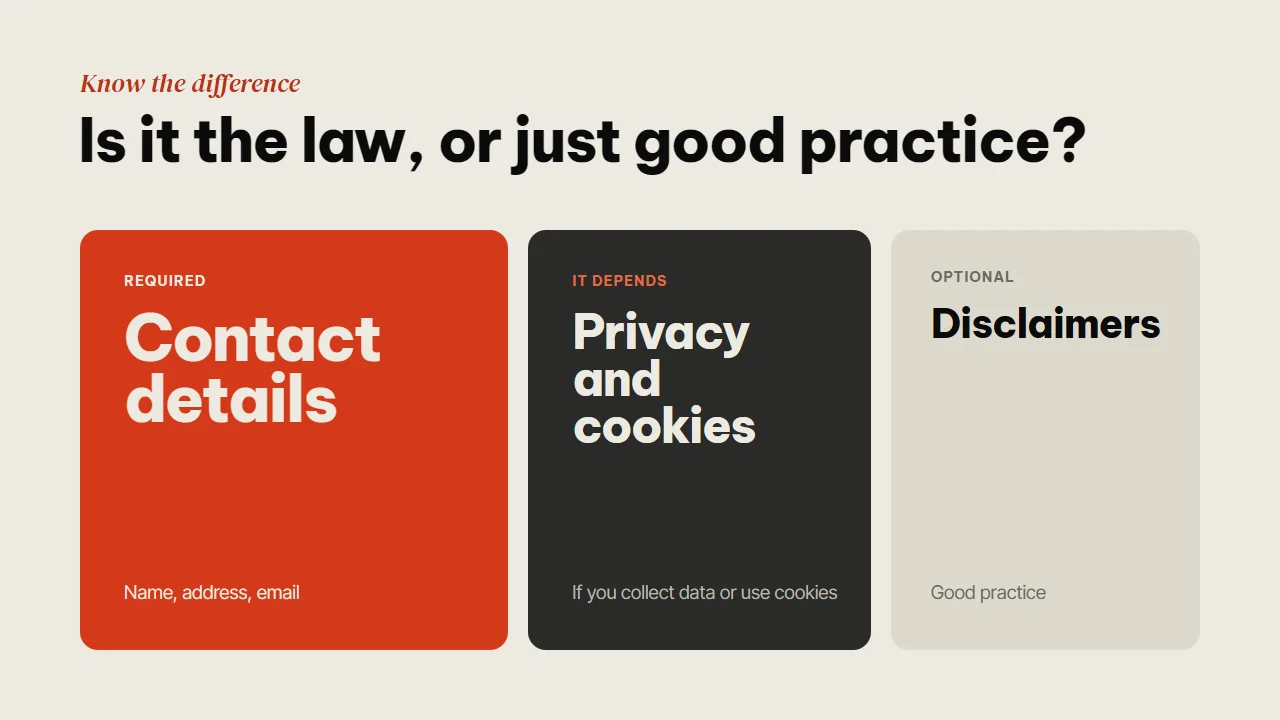
Plenty of footer items are a choice. The table shows which ones the law actually asks for.
| Item | Status | Notes |
|---|---|---|
| Business name, geographic address, email address | Legal requirement | Electronic Commerce Regulations 2002, reg 6 |
| Company number, registered office, place of registration | Legal requirement for companies | Trading Disclosures Regulations 2015, reg 24 and reg 25 |
| Privacy information | Required if the site collects personal data | UK GDPR, Article 13 and Article 14, for example through a contact form, mailing list or analytics |
| Cookie consent | Required for cookies that do not fall within an exception | Privacy and Electronic Communications Regulations, Schedule A1, in force from 2026 |
| Pre-contract information and cancellation rights | Required before a consumer is bound by an online or other distance contract | Consumer Contracts Regulations 2013, reg 13 |
| Terms of use or a disclaimer | Good practice | No general legal duty to have one |
| Copyright notice | Good practice | Copyright protection is automatic, according to GOV.UK |
| Accessibility | Legal duty, but no set technical standard | Service providers must make reasonable adjustments for disabled people (Equality Act 2010, section 29, in Great Britain; Northern Ireland has its own law). No law names a website standard for private businesses. |
Does my website need a privacy policy and a cookie banner in 2026?
A website needs privacy information if it collects personal data, and it needs consent for cookies that do not fall within one of the legal exceptions. A contact form or most analytics tools will collect personal data, so most business websites need privacy information.
The cookie rules changed in 2026. The Data (Use and Access) Act 2025 replaced the old cookie rule in the Privacy and Electronic Communications Regulations, and the change came into force on 5 February 2026 under the commencement regulations. The new rule still requires consent, but Schedule A1 lists exceptions where consent is not needed. These include cookies that are strictly necessary for a service the visitor has asked for, and, if visitors are told about them and given a simple, free way to object, cookies that adapt how the site looks or works to their preferences and some cookies used only to produce statistics for improving the site.
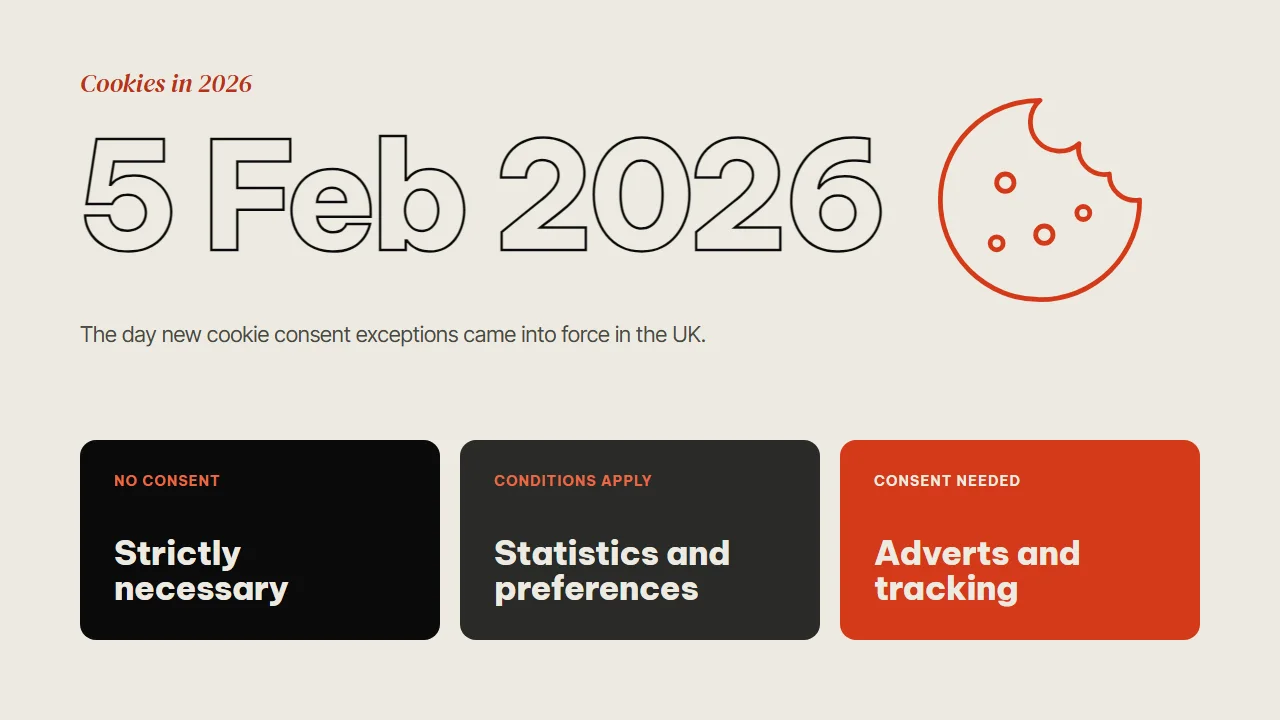
The statistics exception has further conditions. The information must be collected only to improve the service, it must not be shared except with someone helping you make those improvements, visitors must be given clear information about it, and visitors must have a simple, free way to object. Advertising and tracking cookies still need consent. The ICO's guidance, which it finalised on 29 April 2026, also says refusing consent should be as easy as accepting it. The ICO became the Information Commission on 30 September 2026, under section 118 of the Data (Use and Access) Act 2025, and its guidance is still published at ico.org.uk.
Whether a particular analytics tool fits the statistics exception depends on how it is set up. The ICO says a third-party provider must act only on your behalf, as your processor, and use the data only to help you improve your site. If the provider uses the data for its own purposes, such as advertising, you need consent. If you are unsure, use a consent banner or check the ICO's guidance on the exceptions. Many older guides still describe the rules as they stood before February 2026.
What extra rules apply if I sell online?
A business selling to consumers online must give certain information before the customer is bound by the contract. This comes from regulation 13 of the Consumer Contracts (Information, Cancellation and Additional Charges) Regulations 2013 and includes the total price with taxes, delivery charges, how to cancel, and the 14-day cancellation right under regulation 30 where it applies.
These rules are detailed, so this guide does not try to list them all. The government's guide to online and distance selling for businesses is a good starting point.
What should my website footer say?
A website footer is the usual place for the details the law requires, because it appears on every page. These cover the basic details only and are not a full compliance check for your business. They use placeholders. Replace them with your own details and add anything extra that applies to you, such as a VAT number or regulator.
Limited company
Example Trading Ltd. Registered in England and Wales, company number 01234567. Registered office: 1 Example Street, Exampletown, EX1 2MP. Email: hello@example.co.uk
Sole trader
Jane Example, trading as Example Plumbing (sole trader). 1 Example Street, Exampletown, EX1 2MP. Email: hello@example.co.uk
Partnership
Example Joinery (a partnership). 1 Example Street, Exampletown, EX1 2MP. Email: hello@example.co.uk
A missing company number or email address is one of the quieter problems we see on small business sites. Our list of small business website mistakes covers the louder ones.
Frequently asked questions
Is it a legal requirement to have a website for a UK business?
No. There is no law requiring a UK business to have a website. The rules in this guide apply once a business does have a website, and they set out what that website must show.
Is a contact form enough, or do I need to show my email address?
Regulation 6 of the Electronic Commerce Regulations 2002 requires an email address as part of the contact details a business website must show, so a contact form on its own does not meet the wording of the regulation. A form can sit alongside the email address.
Do the details have to appear on every page?
The law does not say every page. Regulation 6 of the E-Commerce Regulations asks for the information to be easily, directly and permanently accessible, and putting it in the footer is the simplest way to achieve that, because the footer appears on every page.
Do sole traders have to show their own name on their website?
Regulation 6 of the E-Commerce Regulations requires the name of the service provider, and for a sole trader the service provider is the person. Showing your own name alongside your trading name is the safest way to meet that wording.
Does a Facebook page or Instagram profile have to follow these rules?
The E-Commerce Regulations do not address social media profiles directly. For limited companies, regulation 29 of the 2015 regulations treats "its websites" as including any part of a website about the company that the company has caused or authorised to appear, which could include its own social media pages. Showing the company name and number on the profile, or linking to a website that shows the full details, is a sensible approach.
Who enforces these rules?
For companies and LLPs, failing without reasonable excuse to show the details required by the 2015 regulations is a criminal offence under regulation 28 for the company and any officer in default. Under regulation 13 of the E-Commerce Regulations, a customer who suffers loss can bring a claim for breach of statutory duty. Consumer and data rules are enforced by bodies such as Trading Standards and the ICO, and no single enforcer covers every rule.
Sources
- Electronic Commerce (EC Directive) Regulations 2002, regulation 6
- Trading Disclosures Regulations 2015, regulation 24 and regulation 25
- Companies Act 2006, section 1202 and section 86
- Provision of Services Regulations 2009, regulation 7 and regulation 8
- Data (Use and Access) Act 2025, section 112 and Schedule A1 to the Privacy and Electronic Communications Regulations
- Electronic Commerce Regulations 2002, regulation 2 and regulation 13
- Trading Disclosures Regulations 2015, regulation 28, regulation 29 and Schedule 6
- Limited Liability Partnerships (Application of Companies Act 2006) Regulations 2009, regulation 14
- Consumer Contracts Regulations 2013, regulation 13 and regulation 30
- UK GDPR, Article 13
- Equality Act 2010, section 29
- Data (Use and Access) Act 2025, section 118 and SI 2026/82, regulation 2
- GOV.UK: How copyright protects your work
- ICO guidance on storage and access technologies
- GOV.UK: Online and distance selling for businesses
Law checked in October 2026. This guide is general information, not legal advice. We are web designers, not a law firm.
Need a website that works this hard?
We design fast, findable websites for UK small businesses. Clear pricing, no jargon.