Contents
- The dual lead funnel: emergency calls versus planned installations
- Emergency callouts: speed, location radius, and mobile ergonomics
- Gas Safe Register compliance and statutory trust signals
- Winning high-ticket planned installations
- Smoothing seasonal revenue: from winter breakdowns to summer servicing
- Commercial contracts and landlord compliance
- Realistic web design for plumbers: build costs and ongoing hosting
- What to do next
When evaluating web design for plumbers across the UK, most heating and plumbing websites make one of two costly mistakes. Either they treat every visitor like an emergency caller with a water pipe pouring through their ceiling, or they bury their contact details behind an elaborate brochure that assumes people want to read essays about pipe fittings before booking a boiler service.
The reality of running a plumbing and heating business is that you deal with two entirely different types of customer. The first has water spraying under their sink or a boiler that locked out in sub-zero weather on a Sunday morning. They need a phone number in two seconds flat. The second is planning a £4,000 combi boiler upgrade, an unvented hot water cylinder installation, or a complete bathroom renovation. They want reassurance, Gas Safe credentials, proof of neat copper work, and a sensible pricing framework before inviting you into their home.
If your site cannot handle both journeys cleanly, you will lose the emergencies to whoever answered their mobile first, and the high-ticket installations to local competitors who look more established.
Key takeaways
- Split the lead funnel: Emergency repairs require instant one-tap calling on mobile, while planned boiler replacements need guided quote capture with photo uploads.
- Gas Safe proof is non-negotiable: Display your registration number clearly in the header and footer, linked directly to the official register to filter out cowboy competition.
- Transparent pricing builds trust: Stating callout fees and rough price brackets for common jobs weeds out tyre-kickers without forcing you to quote blind.
- Smooth seasonal income: Use your site to build recurring revenue through landlord CP12 safety certificates and automated annual boiler service reminders.
- Own your digital platform: Directory listings and social media pages offer zero protection against algorithm shifts or aggressive competitor bidding on your brand name.
The dual lead funnel: emergency calls versus planned installations
A standard trades template bought off the shelf fails plumbers because it tries to force every visitor through a generic contact form. If someone is standing in ankle-deep water in their kitchen, they are not going to fill out an enquiry form asking for their preferred appointment time next Tuesday. They are holding an iPhone in one hand, looking for a tap-to-call button with their thumb.
Conversely, someone whose ten-year-old system boiler is starting to lose pressure does not want to interrupt an engineer under a floorboard just to ask a quick question. They want to know whether you install Worcester Bosch, Vaillant, or Ideal, what kind of warranty you provide, whether you power flush the system as standard, and roughly what a replacement costs. If they land on a page that only offers an emergency callout number, they will bounce straight back to Google and click on a heating firm that explains their installation process clearly.
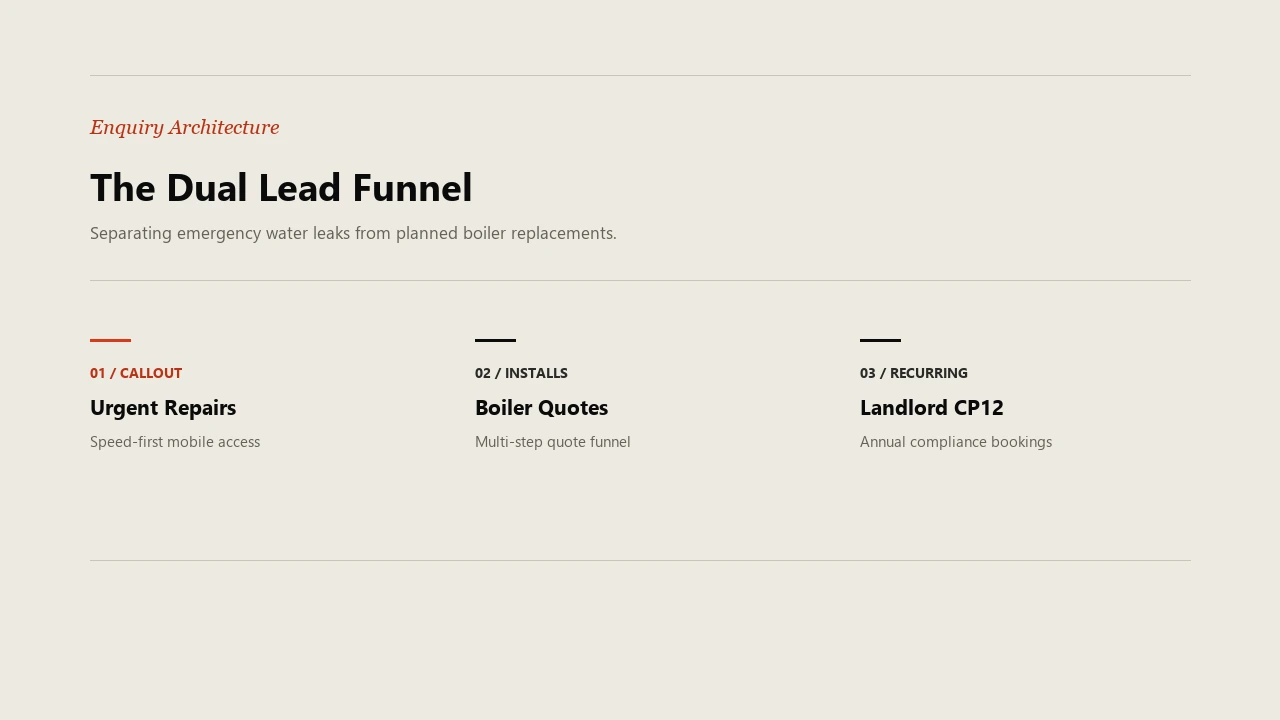
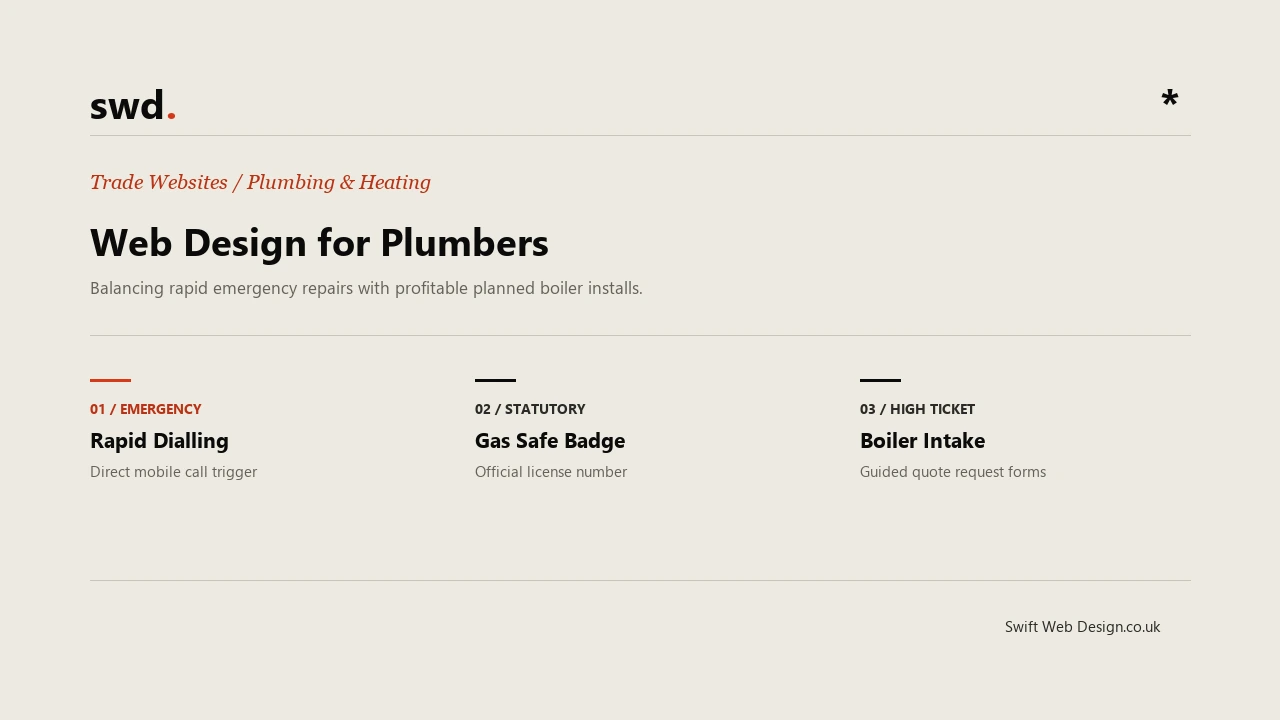
As we explore in our comprehensive guide to websites for tradespeople, dividing your website into distinct user pathways is the single most effective way to improve enquiry quality. When delivering specialised web design for plumbers on our web design for plumbers and heating engineers service, we structure the layout so the emergency number is anchored at the top of the mobile viewport, while the main body content focuses on high-margin installation and renovation projects.
Emergency callouts: speed, location radius, and mobile ergonomics
Mobile traffic accounts for more than 75% of domestic plumbing searches. When an emergency strikes, that figure climbs even higher. Making your site effective for urgent callouts comes down to three operational details:
- Sticky click-to-call triggers: The phone number must stay visible as the user scrolls, rendered as a bold, physical button rather than plain unlinked text. Tapping it must launch the device dialler immediately with no intermediate confirmation screens.
- Explicit coverage areas and postcodes: State your operational radius plainly near the call trigger (for example, "Serving Sheffield, Rotherham, and Chesterfield within a 15-mile radius"). Nothing wastes an engineer's time faster than fielding calls from households two hours away because your site vaguely claimed to cover "Yorkshire and the North".
- Clear out-of-hours pricing terms: State whether you charge a diagnostic fee or emergency callout charge. A transparent note such as "Standard emergency callout: £85 including the first hour of diagnostic labour" instantly establishes professionalism and stops angry disputes on the doorstep.
Gas Safe Register compliance and statutory trust signals
In the UK, working on gas appliances without Gas Safe registration is illegal under the Gas Safety (Installation and Use) Regulations 1998. Homeowners are actively warned by consumer protection groups, estate agents, and insurers to verify registration before hiring an engineer. If your website does not make your Gas Safe registration obvious, you are voluntarily surrendering high-value work to firms that do.
Your registration number should appear in the primary website header, adjacent to your callout button, and inside the global footer. It should also link directly to the official Gas Safe Register verification portal so that cautious customers can confirm your active qualifications in a single click. If you hold specific accreditations (such as unvented hot water G3 certification, LPG qualifications, or commercial gas tickets), list them separately under a dedicated credentials section.
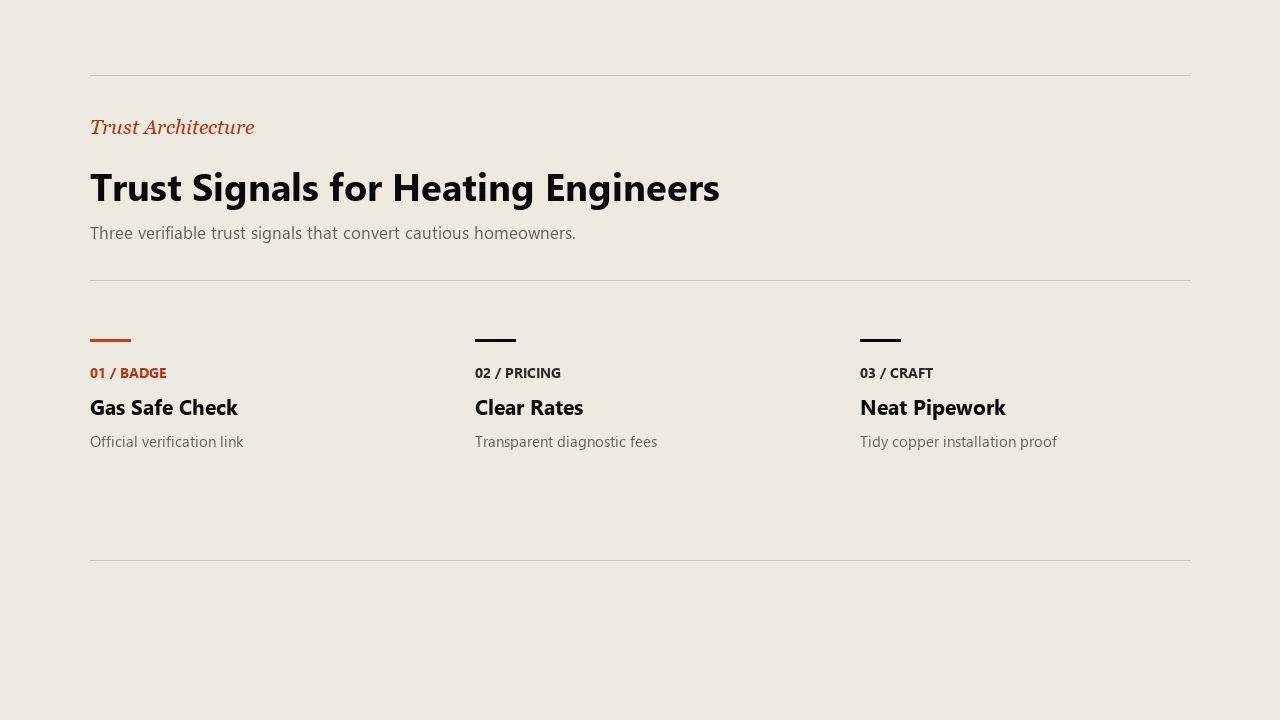
Beyond gas compliance, display your public liability insurance coverage (typically £2m or £5m for domestic work) and manufacturer-approved installer status (such as Worcester Bosch Accredited Partner, Vaillant Advance, or Baxi Approved). These accreditations allow you to offer extended manufacturer warranties of 7 to 10 years, which gives you a huge commercial advantage over unaccredited sole traders.
Winning high-ticket planned installations
Emergency tap washers and leaking waste pipes keep the van rolling, but boiler replacements (£2,200 to £4,500), central heating conversions, and complete bathroom installations (£6,000 to £15,000+) are what build a profitable contracting business. Winning these jobs online requires a structured qualification funnel.
Instead of a standard contact form with a single "Message" box, provide a structured project enquiry form that captures essential job specifications:
- Current boiler type (combi, conventional system, or back boiler).
- Fuel source (mains gas, LPG, or oil).
- Flue termination position (horizontal wall flue, roof vertical flue).
- Number of bedrooms, bathrooms, and radiators in the property.
- Photo upload option for the existing boiler, pipework, and gas meter.
When a homeowner uploads photos of their existing setup, you can often give them a realistic ballpark estimate or identify awkward installation issues before spending an hour driving across town for a site visit. This speeds up your quotation workflow and filters out time-wasters who are merely shopping around for the cheapest day rate.
Smoothing seasonal revenue: from winter breakdowns to summer servicing
Plumbing and heating firms frequently suffer from severe revenue seasonality. Between October and February, phones ring off the hook as freezing temperatures expose old boilers and frozen condensate pipes. Come June and July, enquiry volume drops dramatically as homeowners turn off their radiators and spend their disposable income on summer holidays.
A properly structured website acts as a buffer against this feast-and-famine cycle. By incorporating an automated boiler service booking form and capturing customer contact details at installation, you can build an active maintenance database. Your website can promote summer power flushing packages, annual safety checks, and unvented cylinder inspections when demand is otherwise quiet.
In addition, dedicating pages to bathroom renovations and plumbing alterations ensures you capture domestic refurbishment enquiries that peak during the spring and summer months. Just as we discussed in our guide to website design for builders, showing clear project photography and realistic scheduling timelines for renovation work keeps your order book full all year round.
Commercial contracts and landlord compliance
If you want steady, predictable monthly cash flow that is completely insulated from consumer spending shifts, commercial and landlord work is essential. Letting agents, private landlords, and housing associations manage hundreds of rental properties that require mandatory annual CP12 Gas Safety Certificates and ongoing reactive repairs.
Letting agents do not search for "local emergency plumber". They search for "landlord gas safety certificates Sheffield" or "commercial plumbing maintenance contractor". Creating dedicated landing pages for landlord compliance, offering electronic certificate delivery, and providing trade account invoicing terms will position your business as a dependable commercial partner rather than a casual one-man band.
This dynamic also applies when partnering with other specialist trades. As outlined in our article on web design for electricians, building a visible digital presence makes it easier for general contractors and electrical firms to recommend you on joint renovation contracts where multiple certified trades are needed on site.
Realistic web design for plumbers: build costs and ongoing hosting
Plumbing business owners often ask what a professional website should cost and how quickly it pays for itself. In our detailed breakdown on how much a website costs for a UK small business, we outline exactly what different investment levels deliver.
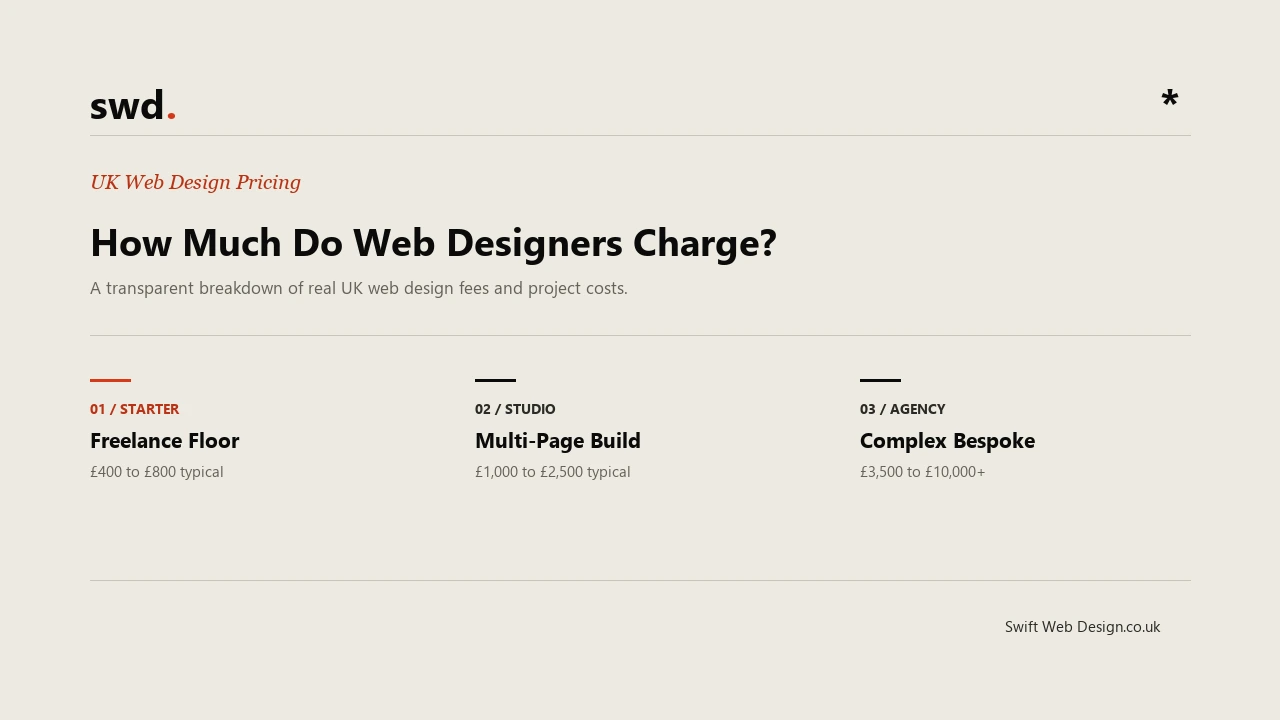
For most independent plumbing and heating engineers, an entry-level professional setup starts at £750 on our Starter package. This delivers a fast, mobile-first website with clean click-to-call integration, Gas Safe trust placement, service pages for emergency plumbing, boiler repairs, and installations, and full Google Business Profile integration. For established heating firms targeting competitive regional markets or offering complex multi-step quote calculators, a Growth package at £1,500 adds dedicated location landing pages, automated review feeds, and advanced lead filtering.
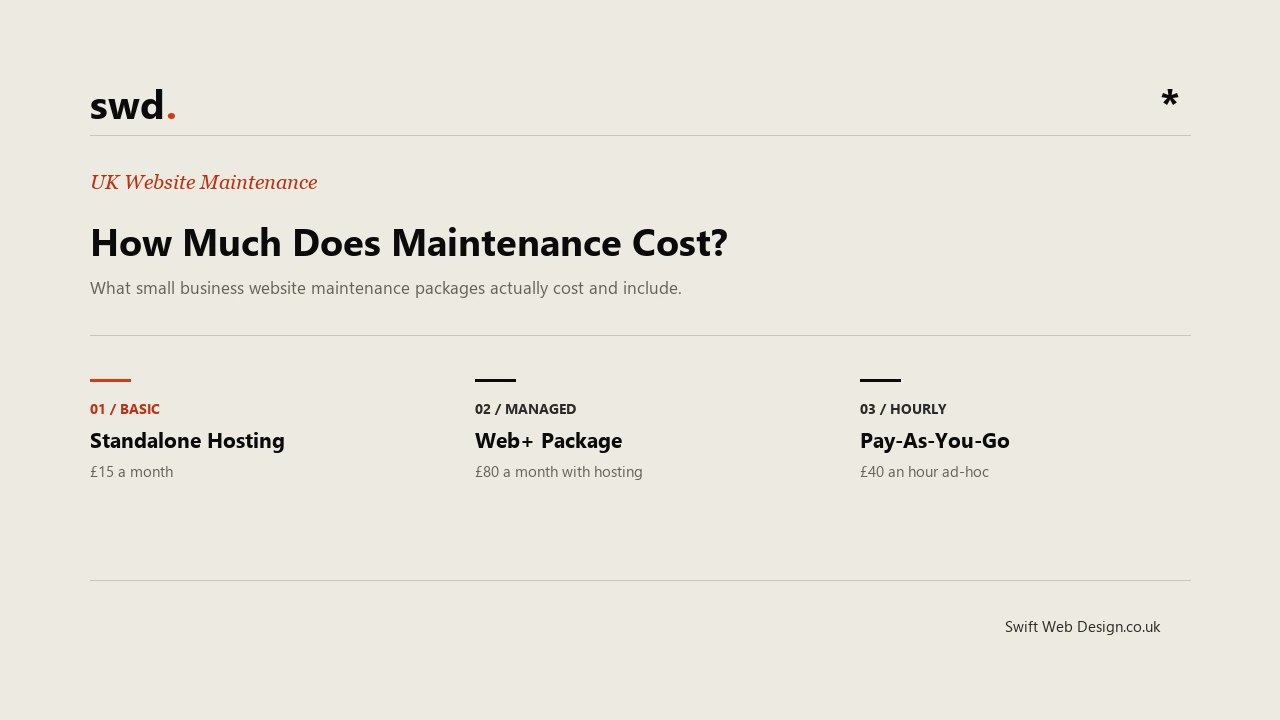
Ongoing costs are straightforward: reliable managed UK hosting is £20 per month, or £60 per month on our Web+ care plan which includes monthly content updates, security monitoring, and regular speed audits. You can check our transparent rates anytime on our live pricing page. When a single boiler replacement delivers £800 to £1,500 in gross margin, a website that wins just one additional installation job every two months covers its entire build cost many times over.
What to do next
If your current website is an outdated template that hides your phone number, or if you are still relying entirely on social media pages and paid directory leads, your business is losing high-margin work to local competitors. Take an objective look at your site on a mobile phone today:
- Can a visitor call you with one tap without pinching and zooming the screen?
- Is your Gas Safe registration number immediately visible and verifiable?
- Do you have dedicated pages for boiler installations, landlord CP12 certificates, and emergency callouts?
- Are you showing real photos of your own neat copper installations rather than generic stock photos?
If the answer to any of those questions is no, investing in proper web design for plumbers is one of the highest-return decisions you can make this year. Take a look at our dedicated plumbing web design service to see how we build high-converting platforms for trade professionals across the UK.
Need a website that works this hard?
We design fast, findable websites for UK small businesses. Clear pricing, no jargon.