
Builders & construction
Websites for builders who would rather be on site.
Your last ten jobs are the best sales tool you own, and most of them are sat in a camera roll. A builder’s website has one real job: get that work in front of someone deciding whether to trust you with their house, whether you work alone or run a small construction firm.
From £400 • No VAT to add • 1–8 weeks • Yours once paid & live

Before they ring
Homeowners look you up first.
Someone is about to let a stranger knock a wall out of their house. Before they ring you, they will search for your name, and what they find decides whether you get the call.
They want to know four things. Is this a real firm, has it done work like mine, is it insured, and will it turn up? A Facebook page with eleven photos and no phone number answers none of them.
So the site is built around those four questions. Finished work comes first, your accreditations sit where people will see them, and the phone number works with one tap.
What goes on a builder’s site
Built around how builders win work.
Each of these removes a reason someone might ring the next firm on the list.
Project galleries that load fast
Extensions, loft conversions, groundwork, renovations. Grouped by job type, so someone planning a kitchen extension can go straight to the kitchen extensions.
Before and after pairs
The same room, shot from the same corner, before and after. We lay the pairs out so the comparison works on a phone screen, which is where most people will see them.
Accreditations where they count
FMB, TrustMark, CHAS, CSCS cards, public liability cover. Shown near the call button, with your membership numbers beside the logos.
Quote forms that ask the right things
Job type, rough timescale, postcode, budget range. So you know what the job is before you ring back.
The towns you cover
If you work across a few towns, the site names them, so people searching from the next town over can still find you.
One tap to call
On a phone, the number is a button. Most builder enquiries come in by phone, and a number hidden on the contact page costs you some of them.
Client work
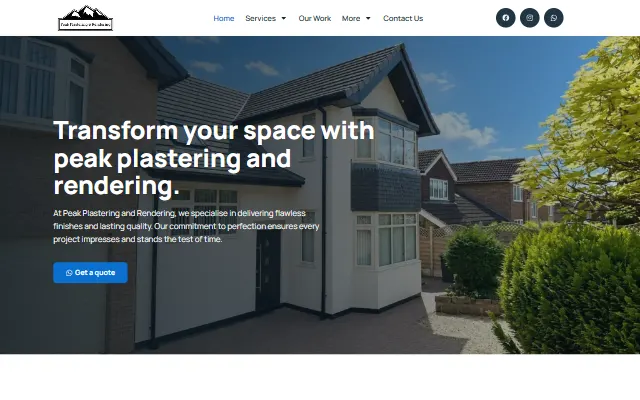
Peak Plastering had no website at all.
An Instagram page, a Facebook profile, a Yell listing, and jobs arriving by word of mouth. Quote requests were getting lost in DM inboxes, which is a slow way to lose work you have already won.
We built the site from scratch, with contact forms for quote requests, a business email address, and local SEO to give nearby customers a better chance of finding them. Enquiries now come in through the website.
We’ve used Swift Web Design and they’ve done what we needed. They’re responsive, and they actually listen when you come to them with ideas. The site they built is clear and it works.Scott M., Co-Founder, Peak Plastering and Rendering
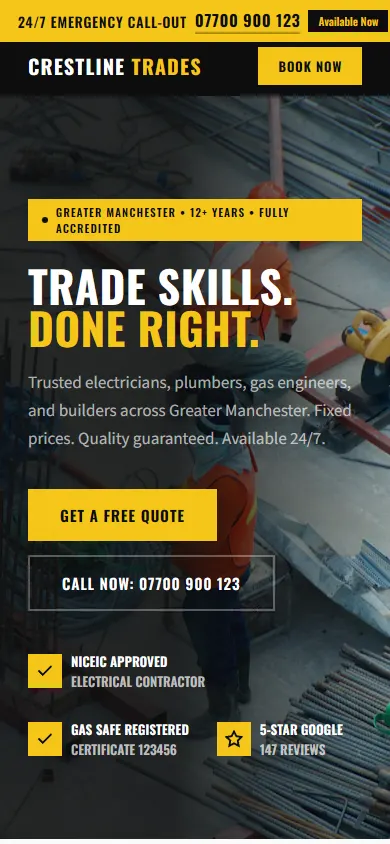
We also built a multi-trade demo called Crestline Trades to show the layout without a client’s name on it. See the demo

A builder’s site is mostly photos, accreditations and a phone number, and it is priced for that, with no day rate ticking over in the background.
Common questions
Questions from builders
Other trades
Related trades and reading
Websites for plumbers
Gas Safe display, emergency call handling and the mobile-first layout that suits callout work.
Websites for electricians
NICEIC and NAPIT numbers, EICR pages and EV charger installs.
Web design in Sheffield
The other half of the partnership, working with trades across South Yorkshire.
Our guide for tradespeople covers why a proper website beats a Facebook page.