Contents
- Key takeaways
- Why word of mouth alone leaves money on the table
- The anatomy of a trades website that converts
- The customer decision journey: recommendation to contract
- Why social media pages and trade directories fall short
- Legal requirements, statutory compliance, and trust signals UK trades must display
- Lead qualification workflows: stopping tyre-kickers without losing good jobs
- The photography problem: how to capture work on active sites
- Price transparency: why stating scopes beats vague estimates
- Tailored advice for specific trade sectors
- Real-world case study: Peak Plastering & Rendering
- What a trades website should cost to build and run
- Local search visibility: getting found in your patch
- Signs your current online setup is holding you back
- How to plan your website launch without overpaying
If you run a trade business in the UK, you have almost certainly heard the same advice from other trades: "Just set up a free Facebook page and rely on word of mouth." For a lot of sole traders starting out with a secondhand van and a handful of local contacts, that advice sounds practical. It costs nothing upfront, takes ten minutes to configure, and lets you post a few photos of a freshly fitted bathroom or a tidy consumer unit between jobs.
The problem is that word of mouth in 2026 does not work the way it worked fifteen years ago. When someone recommends a tradesperson today, the potential client does not simply pick up the phone and hand over a £10,000 deposit. They open Google on their phone, type in your business name, and look for proof. What they find in those first thirty seconds determines whether they call you for an estimate or move on to the next name on their shortlist.
Key takeaways
- Word of mouth needs digital verification: Recommendations initiate the enquiry, but a professional website verifies your legitimacy, insurance, and quality before a high-value contract is signed.
- Facebook pages do not rank for high-intent searches: Local homeowners searching for emergency repairs or major home renovations use Google, where social media profiles rarely achieve visibility.
- A high-converting trade site is an asset you own: Free platforms and directories change their rules, charge fees for unqualified leads, and pit you in price races against lower-quality competitors.
- Sector-specific layouts win profitable work: Tailoring your site structure to your specific trade (such as emergency callouts for electricians and plumbers, or detailed case study galleries for builders) dramatically increases enquiry conversion.
- Statutory compliance protects your business: Displaying your trading entity, regulatory registrations (such as Gas Safe or Part P), and cancellation terms meets UK legal requirements while establishing instant trust.
- Transparent pricing frameworks filter tyre-kickers: Setting baseline scopes and callout fees prevents wasted hours answering dead enquiries without forcing you to quote blindly.
Why word of mouth alone leaves money on the table
Word of mouth is undoubtedly the foundation of any reputable trade business. When you do a solid job, turn up when you say you will, and leave a workspace clean, people talk. But treating word of mouth and a website as mutually exclusive is an expensive misunderstanding of consumer behaviour.
Think about how a modern recommendation actually plays out. A homeowner mentions to their neighbour over the garden fence that they need a full rewiring, an extension, or a replacement boiler. The neighbour says, "We used Dave Smith Electrical last autumn, he was brilliant."
What does that homeowner do next? They do not immediately dial Dave's mobile number. They search "Dave Smith Electrical" on Google. If Dave has a clean, fast website showing his NICEIC accreditation, public liability insurance, recent photos of similar domestic projects, and a clear list of the postcodes he covers, the enquiry is practically secured. Dave looks established, professional, and reliable.
Now consider the alternative scenario. Dave has no website at all, or worse, an abandoned Facebook page whose last post is a blurry photo of a van from August 2022. The homeowner finds an unverified listing on a directory site, encounters no proof of active insurance, and wonders whether Dave is still trading or whether he is just a casual odd-job man. The recommendation is lost, not because Dave's workmanship was poor, but because his digital presence failed to verify his reputation.
The anatomy of a trades website that converts
A successful trade website does not need dozens of pages of generic marketing copy, animated sliders, or corporate jargon. Homeowners looking for a tradesperson want straightforward answers to four practical questions: Do you do the specific work I need? Do you cover my area? Are you qualified and insured? How do I get an accurate price?
To answer those questions in seconds, your site needs a clear, disciplined structure:
- A prominent contact trigger above the fold: On desktop and mobile, your phone number should be visible without scrolling. For mobile visitors, this must be a physical tap-to-call button that immediately opens the phone dialler. If you offer emergency services, state your active response hours and coverage area directly beneath the button.
- Individual service pages: Do not lump every capability into a single bulleted list on your homepage. If you are an electrician, create dedicated pages for consumer unit upgrades, domestic rewires, EV charger installations, and commercial testing. Search engines rank specific URLs for specific queries; a homeowner searching for "fuse board upgrade Sheffield" will click a dedicated, authoritative page long before a generic homepage.
- Genuine project photography with context: Stock photos of pristine American workbenches and models wearing shiny hardhats destroy credibility instantly. Real photos of real work on UK properties, accompanied by a sentence explaining what was installed and where, establish immediate authenticity.
- Verifiable trust signals and accreditations: Badges from recognised industry schemes (such as Gas Safe, NICEIC, NAPIT, Federation of Master Builders, or TrustMark) must be prominent and verifiable. Mention your public liability insurance coverage plainly so clients know their property is protected.
- A low-friction enquiry pathway: Some clients want to call immediately; others prefer sending details in the evening after their children are asleep. Provide a clean contact form that asks for necessary details (such as postcode, project description, and photo uploads) without overwhelming them with unnecessary fields.
The customer decision journey: recommendation to contract
Understanding how potential customers move from an initial recommendation to a signed contract clarifies why every element on your website matters. The journey is not an impulse purchase; it is a systematic process of eliminating risk.
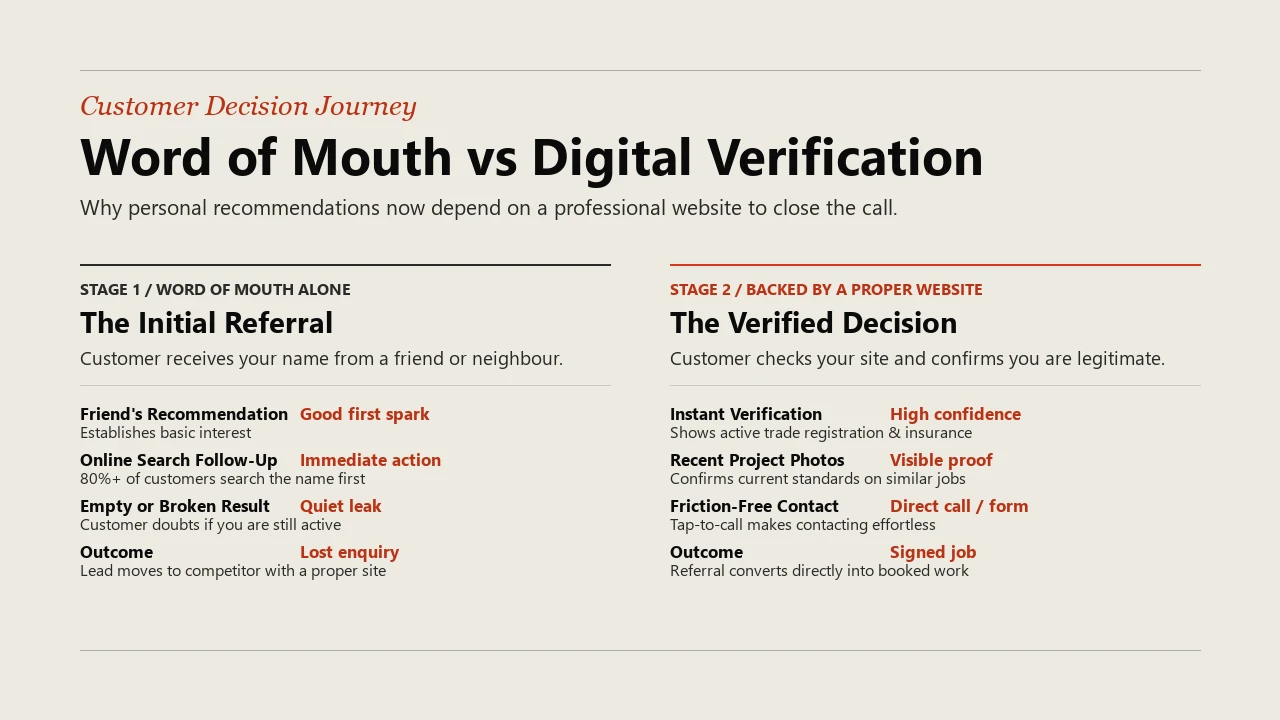
When a client receives your name, they enter the verification phase. They evaluate your professionalism based on your digital footprint. If your site displays clear project scopes, straightforward pricing indicators, and real local reviews, their anxiety drops. When your written estimate arrives, they compare your price against the professional image you have established. A tradesperson with a polished web presence can command professional rates because they have visibly demonstrated competence and accountability.
Why social media pages and trade directories fall short
Many trades rely exclusively on social media platforms or lead generation directories. While both have their place in a wider marketing strategy, relying on them as your sole online presence creates significant operational vulnerabilities.
The limits of social media
Social media algorithms are designed to keep users scrolling through content feeds, not to connect people with local services at the exact moment they need them. Nobody searches a social media feed when their kitchen pipe bursts at midnight or when their RCD switch will not reset. They search Google.
Furthermore, social media business pages offer no control over layout, branding, or competitor adverts. When a potential customer visits your social page, the platform actively serves them adverts for competing trade businesses in the sidebar. You are effectively paying with your own audience attention to fund competitor impressions.
The directory trap
Lead generation directories operate on a business model that is fundamentally misaligned with high-margin trade work. When a homeowner submits an enquiry through a directory, that same lead is frequently sold to four or five different contractors simultaneously. This sparks an immediate race to the bottom on price, forcing skilled tradespeople to compete against uninsured operators who underquote to secure the work.
When you own your own website, every enquiry generated belongs exclusively to you. You set the terms, you explain your value proposition, and you speak directly to the client without an intermediary extracting a percentage or distributing the lead to your local competitors.
Legal requirements, statutory compliance, and trust signals UK trades must display
Operating a trade business in the UK carries strict legal and regulatory responsibilities. Displaying the required statutory information on your website is not just a matter of good practice; it is a legal obligation that immediately separates established businesses from unregistered operators.
Under company law and the Electronic Commerce (EC Directive) Regulations 2002, trade websites must clearly state specific business details:
- Business entity and trading name: If you trade as a limited company, your website must display your full registered corporate name, company registration number, registered office address, and the part of the UK where you are registered (England and Wales, Scotland, or Northern Ireland). Sole traders and partnerships must give their own name, a geographic address and an email address.
- Statutory regulatory schemes: Under the Gas Safety (Installation and Use) Regulations 1998, any business carrying out gas work must be Gas Safe registered. Displaying your active registration number on your site is critical. Similarly, electrical contractors carrying out notifiable domestic work under Part P of the Building Regulations should display their approved contractor status (NICEIC, NAPIT, or ELECSA).
- Consumer Contracts Regulations: Under the Consumer Contracts (Information, Cancellation and Additional Charges) Regulations 2013, domestic customers signing contracts off-premises (such as in their home after an estimate) or online generally have a statutory 14-day cancellation right. Your website terms should clearly outline cancellation procedures, while explicitly noting the statutory exemption for urgent repairs or emergency callouts requested directly by the homeowner.
- Insurance transparency: State the extent of your public liability insurance and employers' liability cover (for example, "£5m public liability insurance with full domestic and commercial cover"). Do not post private policy reference numbers publicly, but confirm that proof of cover is available upon request with every formal written quotation.
Lead qualification workflows: stopping tyre-kickers without losing good jobs
One of the biggest frustrations tradespeople voice about online marketing is the time lost answering phone calls from people looking for five-minute fixes for fifty pence, or homeowners demanding detailed quotations for complex projects two hours outside their working patch. A well-engineered website acts as an automated filter that qualifies inbound interest before it interrupts your working day.
Instead of a bare form with a single text area asking "How can we help?", structure your enquiry workflow to capture essential project parameters:
- Postcode and location filtering: Require an enquiry postcode as a mandatory field. Clearly state your standard operational radius directly above the form (for example, "We provide free estimates across Sheffield and Rotherham; projects beyond a 20-mile radius are quoted on an individual travel basis"). This immediately sets expectations for out-of-area enquiries.
- Photo and file uploads: Enable homeowners to upload photos of their current fuse box, boiler data plate, damaged plaster, or architectural drawings. Seeing the existing setup allows you to identify complex access requirements or obsolete components before spending an hour driving out for a site survey.
- Project scope and realistic timescales: Include simple dropdown selections for project urgency: "Emergency / Within 24 hours", "Next 2 to 4 weeks", or "Planning ahead for next 3 months". This helps you prioritise high-urgency callouts while organising your pipeline of major planned works.
- Separate emergency and planned pathways: Place a dedicated click-to-call button for urgent breakdowns at the top of the mobile screen, while directing planned installations and renovations to a detailed multi-step quote request form. This ensures emergency callers get help immediately without clogging your written enquiry queue.
The photography problem: how to capture work on active sites
The single biggest hurdle tradespeople face when commissioning a website is gathering photography. You are on site to install pipework, wire circuits, or lay brickwork, not to stage photo shoots. The good news is that prospective clients do not want over-produced studio shots; they want authentic evidence of skilled, tidy work on properties just like theirs.
Adopting three simple habits will give you an exceptional library of project images within a few weeks:
- Take consistent before-and-after photographs: Stand in the exact same spot to take a photo before you rip out an old consumer unit or bathroom suite, and take another from the identical angle once your work is commissioned and cleaned down. Before-and-after pairings are among the highest-converting visual assets a trade site can display.
- Clean the workspace before taking the shot: A stunning plastering or tiling installation looks amateur if the foreground is cluttered with half-empty energy drink cans, dirty dust sheets, and stray cable offcuts. Spend ninety seconds clearing the foreground before snapping the picture.
- Focus on detail and neatness: Capture close-up shots of straight conduit runs, perfectly aligned copper bends, neat silicone lines, and crisp plaster margins. Skilled trades recognise good workmanship immediately, and discerning clients notice care and attention to detail.
Price transparency: why stating scopes beats vague estimates
Many trades hesitate to mention pricing on their website for fear of either scaring off budget-conscious customers or underquoting before seeing the job. While quoting fixed prices for complex bespoke work without a site visit is unwise, maintaining complete silence on pricing is equally detrimental.
When a website provides zero indication of cost, visitors often assume the company is either exceptionally expensive or likely to invent arbitrary figures on the doorstep. Providing baseline pricing frameworks resolves this dilemma effectively:
- State standard callout fees plainly: If you charge a minimum diagnostic fee for emergency callouts (such as £80 for the first hour of investigation), publish it clearly. Honest customers respect transparency, and it weeds out individuals expecting free diagnostic labour on a Sunday afternoon.
- Provide typical starting ranges for common jobs: Stating that a complete domestic consumer unit upgrade typically ranges between £600 and £1,100 depending on circuit count, or that a boiler replacement starts from £2,200 including installation and warranty, gives prospective clients a realistic frame of reference.
- Explain what factors alter the final figure: Briefly outlining what causes a quote to vary (such as earthing upgrades, access scaffolding, or material choices) demonstrates expertise and prepares the customer for a thorough site survey.
Tailored advice for specific trade sectors
While the fundamentals of speed, trust, and clarity apply to all contractors, different trade sectors have distinct commercial mechanics that your website architecture must reflect.
Building and general construction
Residential building projects, including extensions, structural knock-throughs, and loft conversions, represent substantial financial commitments often ranging from £20,000 to £100,000 or more. Homeowners committing to projects of this scale require deep reassurance. A builder's website must showcase comprehensive case studies rather than simple photo grids. Each case study should detail the initial brief, architectural challenges, construction timeline, and finished result. For an in-depth analysis of how construction contractors should position their digital presence, explore our dedicated builders web design service.
Electrical contractors
Electrical contractors operate across two very different service categories: urgent domestic callouts and planned domestic or commercial installations. An effective electrician site must feature a prominent emergency click-to-call button with clear callout terms, while dedicating individual pages to Part P registered services such as fuse board replacements, EICR landlord inspections, and EV charger installations. Verifiable registration badges are paramount. Explore our specialised electrician web design service for sector-specific guidance.
Plumbers and heating engineers
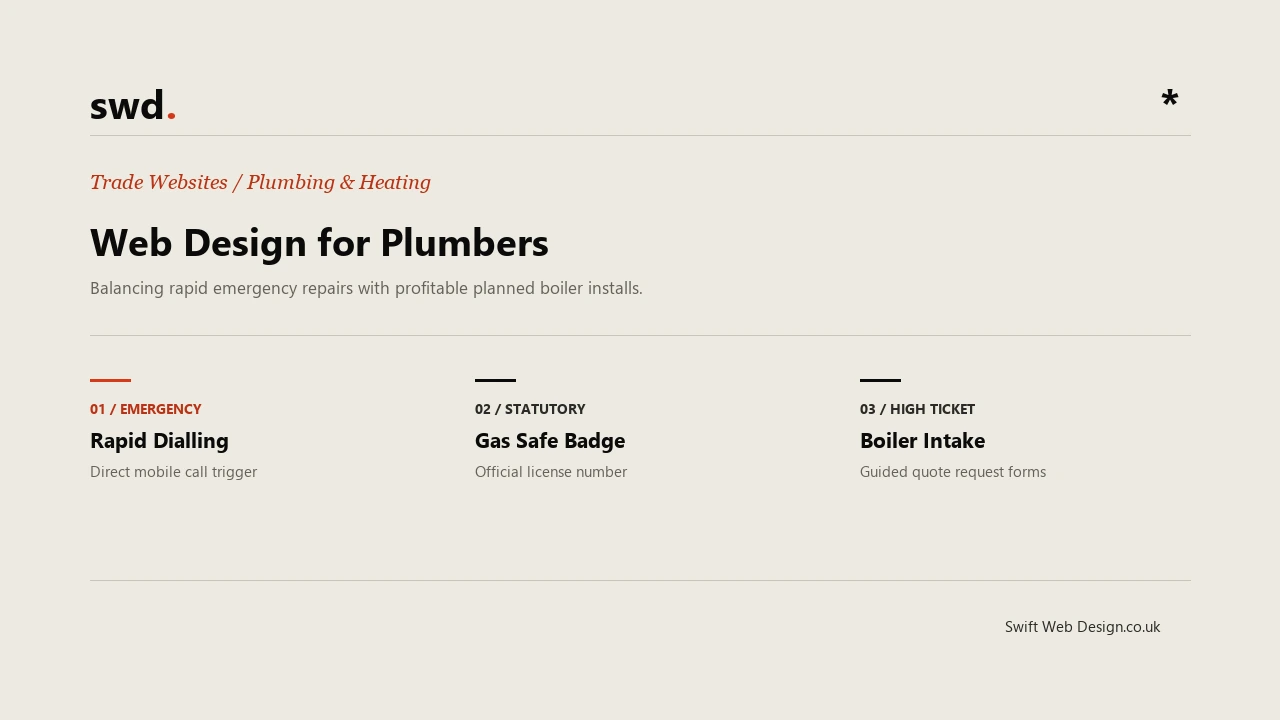
Plumbing and heating engineers face extreme seasonality, swinging from hectic winter boiler breakdowns to quieter summer periods. An effective heating website bridges this gap by dividing the customer journey into two distinct funnels: instant mobile tap-to-call buttons for urgent leaks and boiler lockouts, alongside guided quote requests for planned boiler replacements, unvented hot water cylinders, and bathroom renovations. Displaying your Gas Safe registration number visibly in the header and footer is legally required and provides immediate reassurance to cautious homeowners. To learn how to structure your lead capture, seasonal service agreements, and landlord CP12 compliance pages, visit our dedicated plumbing and heating web design service.
Real-world case study: Peak Plastering & Rendering
The impact of replacing a disjointed digital presence with a purpose-built website is illustrated by our work with Peak Plastering & Rendering (PPAR), a plastering and rendering business.
Before commissioning a website, PPAR relied on a Yell.com listing and social media. That left them without anywhere to properly show the quality of their finished jobs, or an easy route for a new enquiry to get in touch.
We built a clean, fast site with real photos of completed projects, clear ways to request a quote, a fully responsive layout and on-page SEO groundwork for local searches. It now sits alongside their word-of-mouth reputation as a proper first point of contact. You can read the full breakdown in our Peak Plastering & Rendering case study.
What a trades website should cost to build and run
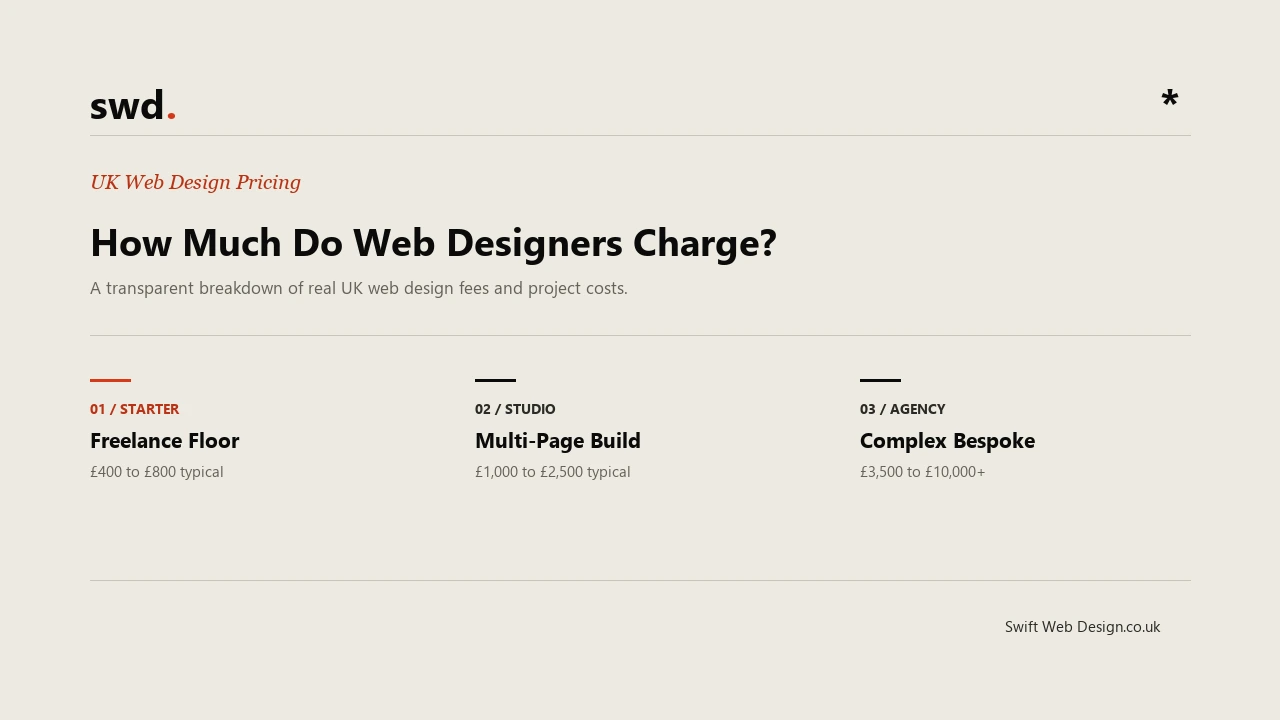
Web design pricing in the UK can be baffling for small business owners, with quotes ranging from a few hundred pounds on freelancer marketplaces to tens of thousands from corporate agencies. In our comprehensive analysis of how much a website actually costs for a UK small business, we provide an honest breakdown of real-world figures.
At Swift Web Design, we believe in transparent, fixed pricing with no hidden day rates and no VAT surprises:
- Simple Website (around £400): Ideal for sole traders and independent contractors who need an established, professional presence. Includes a fast, bespoke single-page or lean multi-section layout, mobile click-to-call integration, service breakdowns, contact capture, and local search setup.
- Standard Website (£400 to £800): Built for expanding trade businesses that need individual service landing pages, project case study galleries, customer review integration, and targeted regional SEO architecture.
- Large and Bespoke Builds (from £1,000; fully bespoke from £1,250): Designed for larger commercial contractors requiring custom functionality, interactive quoting calculators, multi-location targeting, or CRM integration.
Ongoing running costs should be equally transparent. Fast, managed UK hosting is £15 a month if you want us to host your site. For businesses wanting regular updates, basic speed checks, security monitoring, and hands-on support, our Web+ care plan is £80 a month and includes the hosting. You can review all our current rates on our live pricing page.
Local search visibility: getting found in your patch
Building a great website is only half the equation; local homeowners need to be able to find it when they search for trade services in your area. Local search engine optimisation for trades focuses on geographic proximity and customer trust rather than national rankings.
A few foundational practices will ensure your site achieves local search visibility:
- Optimise your Google Business Profile: Your Google Business Profile and your website must work together as a unified system. Ensure your business name, trading address, phone number, and primary categories match exactly across both platforms. For step-by-step guidance on ranking locally, read our guide to getting found locally.
- Implement local structured data markup: Technical schema markup embedded in your website code tells search engines exactly what services you provide, what postcodes you cover, and where your trading base is located.
- Systematise review collection: When you complete a job and the client expresses gratitude, send them a direct link to your Google review page via text or WhatsApp within two hours. Displaying these verified reviews on your website reinforces your reputation and signals active trade to search engines.
- Build dedicated location pages naturally: If your workshop is in Kettering but you regularly serve Corby, Market Harborough, and Wellingborough, create clean, informative location pages that explain your services in those specific areas without resorting to spammy, duplicate content.
Signs your current online setup is holding you back
If you already have a website or online profile, evaluating its current performance honestly is the first step toward improving enquiry numbers. Common warning signs include:
- Your website takes longer than three seconds to load on a 4G mobile connection.
- Visitors have to pinch and zoom the screen to read text or find a phone number.
- Your site uses a generic free email address (such as a personal Gmail or Hotmail account) rather than a professional domain email.
- The copyright notice in your footer displays a year that is three years out of date.
- You receive plenty of spam messages from automated bots, but rarely receive qualified enquiries from local homeowners.
- You have no way of tracking how many people visit your site or which pages generate calls.
Addressing these shortcomings does not require months of disruption. Implementing a structured, modern layout immediately corrects these issues, as detailed in our guide to high-converting website essentials.
How to plan your website launch without overpaying
Taking control of your digital presence does not require a huge marketing budget or weeks of technical frustration. Begin by gathering your core materials: ten to fifteen high-quality photos of completed local jobs, your insurance and regulatory registration numbers, and a clear list of the specific services you want to deliver.
Avoid expensive long-term marketing retainers that lock you into monthly fees before your site has generated a single confirmed lead. Work with a web studio that provides transparent fixed quotes, explains technical requirements in plain English, and hands over complete ownership of your domain and website assets upon launch.
A professional website is not an administrative chore; it is an active sales asset that works twenty-four hours a day, verifying your reputation, attracting high-margin domestic and commercial clients, and establishing your trade business as the premier choice in your area. When you are ready to build an online presence that reflects the quality of your craftsmanship, explore our tailored trade solutions or get in touch through our pricing page.
Need a website that works this hard?
We design fast, findable websites for UK small businesses. Clear pricing, no jargon.