
Contents
- Key takeaways
- Why electrical contracting requires specialised web design
- The four features generic templates always miss
- Why Facebook feeds fail for emergency electrical enquiries
- Balancing domestic callouts and commercial contracts
- Web design for electricians: realistic build costs and running fees
- Collaborating across the construction trades
- Getting your electrical website started
Most electrical contractors in the UK rely on van signage, personal recommendations, and local directories to keep their working week booked. But when property owners face an electrical emergency or plan an expensive rewiring project, their behaviour changes instantly. They turn to Google to find a qualified, registered professional in their immediate area. In this guide, working alongside our comprehensive guide to websites for tradespeople, we examine what web design for electricians actually requires to convert local searches into profitable domestic and commercial jobs.
Key takeaways
- Electrical websites require an emergency callout trigger placed prominently above the fold for mobile users dealing with power loss or urgent faults.
- Displaying competent person scheme registration numbers (such as NICEIC, NAPIT, or ELECSA) near the top builds vital safety trust before a client calls.
- Separate service pages for EV charge points, consumer units, rewiring, and EICR landlord inspections are essential for ranking in local search results.
- A dedicated website captures high-intent customers who are ready to hire today, outperforming passive social media feeds for serious electrical work.
Why electrical contracting requires specialised web design
Electrical work is fundamentally different from cosmetic home improvements like painting or landscaping. Homeowners hire an electrician because they need safety, compliance with building regulations, and technical competence. A mistake in an electrical installation can cause property damage or severe injury, which makes customers naturally cautious when choosing someone new.
A generic template website designed for general businesses fails because it treats an electrician like a retail shop. It buries emergency phone numbers, lacks dedicated spaces for regulatory credentials, and groups complex technical services into vague bullet points. To win high-value installations and urgent callouts, your site must reassure visitors on safety within seconds of opening.
The four features generic templates always miss
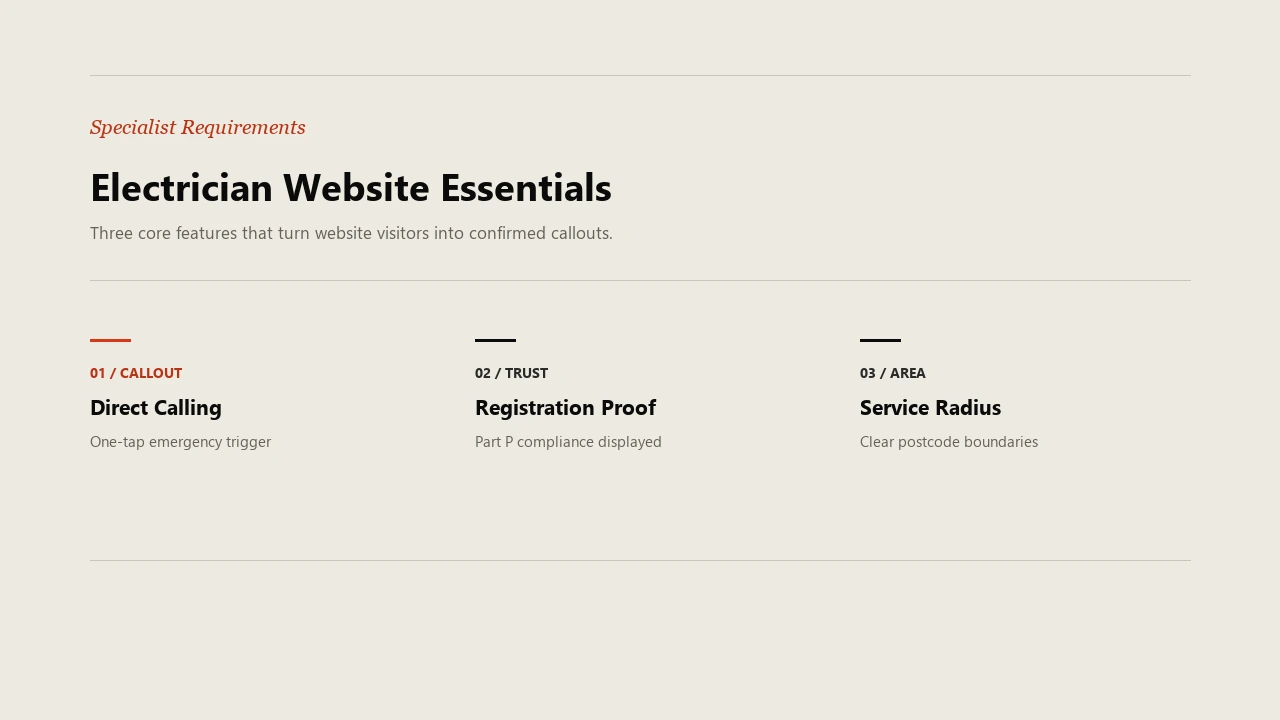
When we build websites for electrical contractors, we focus on four functional elements that directly influence whether a visitor contacts you or clicks back to Google search results.
1. Immediate emergency callout visibility
When a domestic consumer unit trips repeatedly on a Friday evening, or a shop loses power, the customer is not researching company history. They need an emergency electrician immediately. Your website must feature a fixed, high-contrast click-to-call button at the top of the mobile screen. If a frantic caller has to hunt through three navigation menus to find a telephone number, you have lost that callout to a faster competitor.
2. Prominent credential and scheme display
Displaying your registration with an approved competent person scheme is one of the most effective trust signals you can provide. Whether you are registered with NICEIC, NAPIT, or ELECSA, your scheme badge and official registration number should appear near the top of the page, ideally linking to the official NICEIC register. As we implement on our dedicated web design for electricians service, placing credentials beside your primary call button reassures cautious homeowners and landlords that your work meets British Standards and Part P building regulations.
3. Dedicated pages for individual services
A single services page listing rewires, fault finding, and socket replacements will struggle to rank on search engines. To attract lucrative work, you need dedicated pages for specific, high-intent searches:
- EV charger installation: capturing growing domestic and commercial demand for home charging points and grant-funded workplace chargers.
- Consumer unit upgrades: explaining the benefits of modern RCBO and surge protection boards for older properties.
- EICR landlord certificates: attracting recurring testing and inspection contracts from private landlords and letting agencies who require regular five-year compliance checks.
- Full and partial rewiring: establishing your capability to handle major domestic renovations, kitchen refits, and commercial premises upgrades.
4. Clearly defined service territory
Electricians cannot afford to waste time answering phone calls from customers located two hours away. Your website should clearly list your primary operating towns, postcodes, and driving radius. This not only filters out unsuitable enquiries but also signals to Google exactly where your business should rank in local map packs.
If you cover emergency callouts within a fifteen-mile radius but travel up to thirty miles for full domestic rewires and commercial testing, make that distinction clear. Explaining your radius prevents awkward telephone conversations and keeps your fuel costs under control.
Why Facebook feeds fail for emergency electrical enquiries
Many electrical contractors ask whether maintaining a Facebook business page is enough. While social media is useful for showing community presence or posting casual project updates, its search mechanics do not match how people buy electrical services.

When a homeowner smells burning plastic from a socket or suffers a complete lighting failure, they do not open Facebook to browse newsfeeds. They search Google on their phone with high intent. An owned website captures customers at the exact moment their intent to hire peaks, giving you direct access to urgent, profitable work without paying platform commissions.
Social media posts also bury older work quickly. A customer looking for an electrical vehicle charger installation does not want to scroll through eighteen months of banter and holiday notices to find a photo of a clean garage install. A website neatly categorises your work into accessible galleries that can be viewed in seconds.
Balancing domestic callouts and commercial contracts
A common challenge for growing electrical contractors is moving beyond small domestic repairs to secure steady commercial maintenance, retail fit-outs, or industrial testing. Your website structure plays an essential role in managing this transition.
By creating clear separate pathways on your homepage for domestic homeowners and commercial facilities managers, you can speak to both audiences effectively. Commercial clients care about public liability coverage (typically £5m or £10m), out-of-hours availability, RAMS documentation, and scheduled maintenance capability. Presenting these details clearly positions your firm as an established contractor capable of handling substantial commercial tenders.
Web design for electricians: realistic build costs and running fees
We believe in transparent pricing without ambiguous day rates. As outlined in our guide on how much a website costs for a UK small business, a professional trade website typically costs between £400 and £1,200 depending on page count and technical features. You can inspect all current packages and calculate your own estimate on our live pricing page.
Because our builds come on fixed quotes with no added VAT and five revision rounds included, you know your exact investment before any work begins. Ongoing hosting sits at £15 a month, or £80 a month if you want our Web+ care package to handle weekly backups, security patches, and minor text updates for you.
Collaborating across the construction trades
Electrical installations frequently overlap with larger building works, kitchen extensions, and heating upgrades. As we discuss in our companion guide on website design for builders, and on our page for plumbers, establishing a polished online presence makes it much easier to partner with local general builders and heating engineers who need dependable electrical subcontractors they can recommend with pride.
Getting your electrical website started
To get started, you do not need weeks of complex planning. Gather your trade registration numbers, photos of three or four tidy consumer unit installs, and a list of your core service towns. A clean, purpose-built site can be live within two to four weeks, ready to capture local enquiries and establish your business as the premier electrical contractor in your area.
Need a website that works this hard?
We design fast, findable websites for UK small businesses. Clear pricing, no jargon.